Medical forceps are among the most frequently used instruments in hospitals, clinics, emergency rooms, dressing stations, operating theatres, laboratories, and first-aid environments. Although forceps may appear simple compared with powered medical equipment, their performance directly affects handling precision, tissue protection, dressing efficiency, and procedural control. A well-designed forceps must provide a secure grip, predictable movement, appropriate reach, and dependable alignment throughout repeated use.
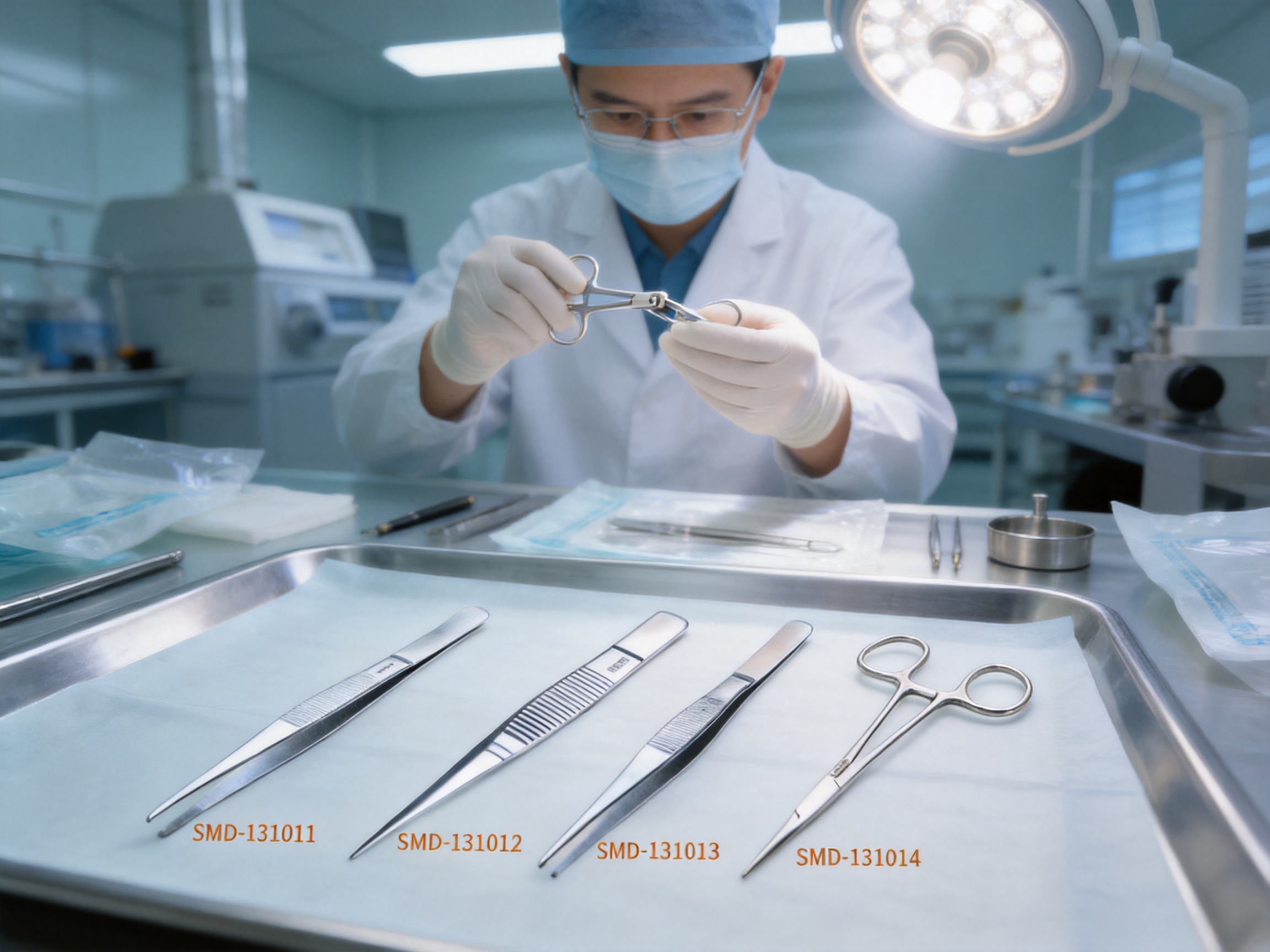
The Forceps series identified as SMD-131801 through SMD-131804 is designed to cover several common clinical and emergency-care requirements. The range includes dressing forceps, tissue forceps, anatomical forceps, and surgical hemostatic forceps. Available lengths extend from 12.5 cm to 25 cm, allowing medical professionals to select an instrument according to the working distance, procedural field, and level of access required.
This product range is supplied by a professional manufacturer and exporter with extensive experience in first aid, wound care, medical supplies, surgical consumables, and medical instruments. Its manufacturing and quality-control capabilities are supported by production bases in Jiangsu, Zhejiang, and Anhui Province, together with quality systems intended to meet ISO 13485:2016 requirements. The company also reports that most of its products are CE certified and that its Suzhou factories comply with FDA requirements.
For distributors, hospitals, first-aid suppliers, medical retailers, and private-label buyers, the forceps series offers a practical combination of product variety, established manufacturing support, international market experience, and quality-management capability. It is suitable for organizations seeking dependable general-purpose instruments rather than a single limited-use configuration.

Forceps
1. Overview of the Forceps Product Range
Forceps are manually operated instruments used to grasp, hold, lift, separate, guide, or compress materials during medical procedures. Their applications range from simple wound dressing and removal of medical materials to tissue handling and surgical control of bleeding vessels. Because different procedures require different jaw shapes and operating characteristics, a complete instrument range is generally more useful than one universal pattern.
The SMD-131801 to SMD-131804 series addresses four functional categories:
| Model |
Instrument Type |
Available Size |
Typical Functional Area |
| SMD-131801 |
Dressing forceps |
12.5 cm, 14 cm, 16 cm, 18 cm, 20 cm, 25 cm |
Wound dressing, gauze handling, and general clinical use |
| SMD-131802 |
Tissue forceps |
12.5 cm, 14 cm, 16 cm, 18 cm, 20 cm, 25 cm |
Controlled handling of tissue during suitable procedures |
| SMD-131803 |
Anatomical forceps |
12.5 cm |
General anatomical and clinical handling |
| SMD-131804 |
Surgical hemostatic forceps |
12.5 cm, 14 cm, 16 cm, 18 cm, 20 cm, 22 cm |
Clamping and control applications in surgical procedures |
The broad range of lengths is an important practical feature. Shorter forceps are generally convenient for superficial work and compact treatment areas, while longer forceps can provide additional reach and help keep the operator’s hands farther from the working field. The correct selection must always be based on the procedure, the instrument design, the healthcare facility’s protocol, and the professional judgment of the user.
The series can be used as part of a wider medical-instrument purchasing program. A distributor may stock several lengths of the same functional pattern, while a hospital purchasing department may standardize commonly used sizes across treatment rooms. Offering four related instrument categories also makes it possible to assemble procedure-specific kits for dressing care, minor treatment, emergency care, and surgical departments.
2. Dressing Forceps: SMD-131801
Dressing forceps are commonly used for handling gauze, cotton, dressings, and other materials during wound-care procedures. The SMD-131801 model is offered in six lengths: 12.5 cm, 14 cm, 16 cm, 18 cm, 20 cm, and 25 cm. This selection allows buyers to match the forceps to the working environment instead of relying on one standard size for every application.
In first-aid rooms and outpatient treatment areas, a shorter dressing forceps can be practical for close, visible work. In larger treatment fields or situations where additional reach is useful, longer versions may be selected. The variety also supports different user preferences and procedural arrangements. Nurses, physicians, emergency-care personnel, and wound-care specialists may choose different lengths depending on hand position, access, and the distance between the operator and the patient.
A key advantage of dressing forceps is their ability to support controlled handling of wound-care materials. Direct handling with fingers may be inconvenient, may reduce precision, or may not be appropriate under the facility’s infection-control protocol. A suitable instrument allows the operator to place, lift, adjust, or remove materials with a more controlled motion.
For medical distributors, the six-size selection can simplify product segmentation. Smaller facilities may begin with the most frequently requested lengths, while larger institutions can maintain a complete size range. The same model family can be presented in catalogs and procurement systems without requiring customers to learn a different product structure for every size.
When compared with low-cost forceps that are available in only one or two lengths, a broader dressing-forceps range provides a more flexible purchasing solution. It can reduce the need to source different models from multiple suppliers and may support more consistent instrument management within a healthcare organization.
3. Tissue Forceps: SMD-131802
Tissue forceps are intended for controlled tissue handling during appropriate medical and surgical procedures. The SMD-131802 model is available in the same six lengths as the dressing-forceps model: 12.5 cm, 14 cm, 16 cm, 18 cm, 20 cm, and 25 cm. The shared size structure makes it easier for users to compare and select instruments within the range.
Tissue handling requires attention to control, visibility, and the characteristics of the working area. The selected forceps should correspond to the procedure and the professional’s technique. A shorter instrument may offer a direct hand feel in a superficial field, whereas a longer instrument may help reach a deeper or less accessible area. The product range supports this selection process without forcing every procedure to use the same working length.
Hospitals and clinics can use the model as part of their general surgical-instrument inventory. It may be purchased for procedure rooms, dressing stations, minor-surgery units, teaching facilities, and emergency-care departments, subject to institutional requirements and the intended configuration of the instrument.
From a procurement perspective, having dressing and tissue forceps with matching length options has several advantages. It allows an institution to develop a consistent storage system, organize instruments by size, and train staff on a recognizable series. It can also make replenishment more straightforward because replacement orders can reference a stable model number and established length.
The competitive value of this model is therefore not based only on the basic function of grasping. It also comes from range organization, availability of multiple sizes, compatibility with broader product procurement, and support from a supplier experienced in medical consumables and instruments.

4. Anatomical Forceps: SMD-131803
The SMD-131803 model is identified as anatomical forceps and is listed in a 12.5 cm size. Anatomical forceps are used in general clinical and anatomical handling applications where the user needs an instrument designed for controlled manipulation rather than a hemostatic clamping function.
A dedicated anatomical-forceps option is useful for facilities that want to distinguish between instruments intended for tissue handling, dressing work, and clamping. Clear functional classification can help reduce inappropriate instrument selection, improve tray organization, and simplify training for new staff.
The 12.5 cm format is a compact option for close working areas. It can be considered for outpatient rooms, emergency treatment areas, basic procedure kits, and other locations where a shorter instrument is preferred. As with all medical instruments, the healthcare professional must confirm that the specific design is appropriate for the intended use and follow the facility’s sterilization and handling procedures.
For distributors, the anatomical-forceps model complements the longer size options of the dressing and tissue categories. It creates a balanced catalog structure: one compact anatomical pattern, a multi-size dressing pattern, a multi-size tissue pattern, and a multi-size hemostatic pattern. This helps a supplier offer a practical basic forceps selection without presenting an excessively complicated range.
5. Surgical Hemostatic Forceps: SMD-131804
The SMD-131804 model is listed as surgical hemostatic forceps and is available in 12.5 cm, 14 cm, 16 cm, 18 cm, 20 cm, and 22 cm sizes. Hemostatic forceps are used in surgical environments for controlled clamping applications associated with hemostasis. Because hemostatic procedures are clinically significant, the instrument must be selected, handled, cleaned, sterilized, and maintained according to professional and institutional requirements.
The available length range supports different procedural needs. The 12.5 cm and 14 cm versions may be suitable for more localized work, while longer versions may provide additional reach in a larger operative field. The 22 cm option extends the range while remaining distinct from the 25 cm maximum offered for the dressing and tissue models.
A multi-size hemostatic-forceps offering can be valuable for operating-room procurement. Different procedures may require different lengths, and a standardized family of instruments can make tray preparation more systematic. It may also support replacement planning, because staff can identify the required size using the model number and length rather than relying only on visual comparison.
Compared with general-purpose gripping instruments, a hemostatic forceps model is designed for a more specific clinical function. Its inclusion in the series demonstrates that the product line is not limited to first-aid dressing applications. It extends into surgical and nursing environments, making the supplier relevant to a wider range of healthcare buyers.
The product information supplied for this range does not specify the exact jaw profile, locking mechanism, surface finish, material grade, or reprocessing classification. Buyers should confirm these details before placing a purchase order, especially when the forceps are intended for surgical use. Product documentation, samples, technical drawings, and applicable conformity documents should be reviewed as part of the procurement process.
6. Why Instrument Size Matters
Forceps length affects handling, reach, visibility, balance, and the distance between the operator’s hand and the treatment area. A correct size can contribute to more comfortable manipulation, while an unsuitable size may make a procedure unnecessarily difficult. For this reason, a range that includes several lengths is usually more useful than a one-size product.
Short forceps are often selected when the target area is close to the operator and precise hand control is important. Medium-length forceps can provide a balance between reach and tactile feedback. Longer forceps can help access areas that are farther from the operator’s hand and may be useful when additional clearance is needed.
Size selection should not be made solely on the basis of length. The user should also consider the jaw pattern, intended function, patient position, procedure type, visibility, and whether the instrument is intended for reusable or other regulated use. Healthcare institutions should establish selection and reprocessing policies that reflect their clinical environment.
The SMD-131801 and SMD-131802 models offer six lengths from 12.5 cm to 25 cm. SMD-131804 offers six lengths from 12.5 cm to 22 cm, while SMD-131803 is listed at 12.5 cm. This organized structure gives purchasing teams a clear framework for comparing options and maintaining a consistent inventory.
7. Advantages for Hospitals and Clinical Users
One advantage of the series is functional coverage. A hospital can source several common forceps categories from one product family instead of purchasing every instrument from a separate supplier. Consolidated sourcing may simplify communication, quotation management, product approval, and replenishment planning.
A second advantage is size flexibility. Medical departments do not all work in the same way. Emergency rooms, outpatient treatment areas, dressing clinics, operating theatres, and nursing stations may have different requirements. The availability of multiple lengths lets each department select instruments that fit its procedures.
A third advantage is catalog clarity. The model numbers distinguish dressing, tissue, anatomical, and hemostatic applications. This can reduce ambiguity during ordering and make it easier to match purchase requests to the intended use. Clear identification is particularly valuable for distributors that serve hospitals with formal procurement systems.
A fourth advantage is supplier breadth. The manufacturer’s broader portfolio includes first-aid products, wound dressings, medical gauze, bandages, medical tape, cotton products, non-woven products, sports bandages, family healthcare products, syringes, catheters, surgical consumables, and other medical supplies. Buyers that already source these categories may benefit from a wider supplier relationship.
A fifth advantage is international supply experience. The company reports exports to more than 60 countries, including markets in Europe, Southeast Asia, Africa, and Oceania. International experience can be valuable when buyers require export documentation, product communication across different markets, or coordination with local distribution networks.
8. Advantages Compared with Less-Organized Alternatives
Many basic forceps on the market are offered as isolated items with limited information about model structure, size availability, or supplier capabilities. A product range with clear model numbers and defined lengths can provide a more organized alternative. This is especially useful for professional procurement, where repeatability and traceability are important.
Another potential advantage is the ability to develop a complete purchasing package. Instead of buying dressing forceps from one source, tissue forceps from another, and hemostatic forceps from a third, a customer can evaluate a coordinated series. This may reduce administrative work and create a more consistent product presentation for distributors.
Supplier manufacturing depth is also relevant. A company with production bases in several provinces and a long history in medical devices may be better positioned to support sustained orders than a small trading operation with limited production control. Manufacturing scale does not replace product verification, but it can support capacity planning, quality management, and continuity of supply.
The company’s reported quality-control organization, comprising hundreds of personnel, is another important strength. A large quality team can support incoming-material inspection, process control, final inspection, documentation review, and corrective-action activities. The exact inspection plan for these forceps should be confirmed with the supplier, but the broader quality infrastructure is a positive consideration during supplier evaluation.
Buyers should nevertheless compare products objectively. Important comparison points include jaw alignment, grip performance, dimensional consistency, surface quality, hinge movement, corrosion resistance, locking performance where applicable, packaging, cleaning instructions, sterilization compatibility, regulatory status, and after-sales support. The series provides a strong basis for evaluation, but technical confirmation remains essential.

9. Manufacturing and Quality-Control Strengths
Medical instruments require consistent production because small dimensional differences can affect handling and clinical performance. For forceps, manufacturing quality may influence the alignment of the jaws, smoothness of movement, reliability of the hinge, consistency of the working length, and overall user confidence.
The manufacturer describes itself as an experienced producer and exporter of first-aid, medical, and healthcare products. Its reported 30 years of industry experience provides a substantial background in medical-device production, medical consumables, and healthcare supply. This experience is relevant because forceps are supplied within a broader medical-product system rather than as an unrelated general hardware item.
Multiple production bases in Jiangsu, Zhejiang, and Anhui Province provide a broader manufacturing foundation. Different production locations can support different product categories, capacity planning, and supply continuity. Buyers should ask the supplier which facility produces the forceps, how production is controlled, and whether the same specifications apply across different manufacturing locations.
The company reports that its quality-control team follows inspection procedures aligned with ISO 13485:2016 standards. ISO 13485 is widely associated with quality-management systems for medical devices. A quality system based on this standard typically emphasizes documented procedures, risk-based controls, traceability, design and production processes, complaint handling, and corrective actions. The presence of a quality system is important because reliable medical instruments depend on repeatable processes rather than final inspection alone.
The company also states that most of its products are CE certified and that its Suzhou factories comply with FDA requirements. These statements should be interpreted product by product. Buyers should request the relevant declaration, certificate, registration information, labeling, and technical documentation for the exact forceps model and intended market. Certification or compliance for one product does not automatically prove the status of every product in a supplier’s portfolio.
Advanced manufacturing should be understood as a complete process. It includes controlled purchasing, approved materials, equipment maintenance, production instructions, operator training, inspection standards, batch identification, packaging control, and documented release procedures. For a forceps range, these controls should be applied consistently across every length and functional category.
9.1 Process Consistency
Process consistency is essential when several sizes share a common design. The 12.5 cm and 25 cm versions of a dressing forceps should remain recognizable as members of the same product family, while still meeting their respective dimensional requirements. Consistent model coding and inspection criteria make it easier to identify deviations and manage replacements.
9.2 Inspection and Documentation
Inspection documentation helps manufacturers and buyers verify that products meet agreed specifications. Depending on the product configuration, relevant checks may include overall length, jaw alignment, opening and closing action, surface condition, hinge function, markings, packaging, and quantity. The final inspection plan should be confirmed with the supplier because the provided product information does not list every technical test.
9.3 Production Capacity
Production capacity matters to wholesalers and institutional buyers that require repeat orders. A supplier with multiple manufacturing bases and experience serving international markets may be able to support larger or more regular purchasing programs. Buyers should still confirm lead time, minimum order quantity, production scheduling, sample approval procedures, and contingency planning before entering into a supply agreement.
10. Use in First Aid, Wound Care, and Nursing
The dressing and anatomical forceps in this series are relevant to first-aid and nursing environments. First-aid suppliers may include forceps in emergency kits, wound-care kits, dressing sets, and general treatment packs. Nursing departments may use suitable forceps when handling gauze, dressings, or other materials according to local procedures.
In wound care, organization and hygiene are important. Instruments should be stored in a clean and controlled manner, used only for their intended purpose, and processed according to the facility’s validated procedures. The product range can support standardized kit preparation by providing identifiable models in several lengths.
Emergency environments may benefit from simple product identification. In a time-sensitive situation, staff should be able to distinguish an instrument’s intended function quickly. Model numbers and clear packaging information can help support this process, provided the facility has an appropriate inventory-management system.
Forceps do not replace professional training or clinical judgment. Their use should follow the instructions provided by the healthcare institution, applicable infection-prevention procedures, and the recommendations supplied with the product. Buyers should also determine whether a particular version is intended for sterile, non-sterile, reusable, or other specified use before placing it into service.
11. Use in Surgical and Procedure Areas
The hemostatic model is intended for surgical applications, while tissue and anatomical models may be used in suitable procedure settings. Surgical departments require particularly careful control of instrument selection, processing, inspection, and storage. Instruments should be examined before use for visible damage, functional problems, contamination, or other conditions that could affect safe performance.
Reusable instruments, when applicable, must be cleaned and sterilized through validated processes. The specific reprocessing method depends on the product’s material, construction, labeling, and intended regulatory classification. Because these details are not included in the supplied description, professional buyers should request the manufacturer’s instructions before clinical deployment.
Operating-room purchasing teams may evaluate the forceps according to several criteria: whether the instrument opens and closes smoothly, whether the jaws meet correctly, whether the lock functions as expected for the hemostatic pattern, whether the surface is free of defects, and whether the instrument remains stable after repeated processing. Samples and technical specifications can be useful during approval.
Standardizing instruments by model and size can also support surgical-tray management. A tray list may specify the required forceps type and length, helping staff identify missing, damaged, or incorrectly substituted instruments. This may contribute to more efficient preparation and more reliable inventory control.
12. Packaging, Distribution, and Private-Label Opportunities
Medical distributors often require products that can be integrated into existing catalogs and sales channels. The four-model forceps structure is suitable for catalog presentation because each model has a defined purpose and a recognizable size range. Distributors can list the instruments individually or combine them into procedure-oriented assortments.
The manufacturer’s experience with OEM medical consumables and medical devices may be relevant to buyers seeking customized packaging, product labeling, or private-label arrangements. The specific services available for the forceps should be confirmed directly. Questions may include packaging format, label language, carton configuration, barcode options, product markings, inspection documents, and minimum order quantities.
International distribution also requires attention to market-specific requirements. Buyers should confirm whether product labels, instructions, symbols, declarations, import documents, and packaging information meet the requirements of the destination market. A supplier’s experience in Europe, Southeast Asia, Africa, and Oceania can help facilitate communication, but the importer remains responsible for confirming local obligations.
For wholesalers, the range can be positioned as a practical general-medical-instrument line. For hospitals, it can be evaluated as part of a broader supply contract. For first-aid companies, the dressing and anatomical models may be suitable additions to wound-care kits. For surgical distributors, the tissue and hemostatic models may offer complementary products for procedure-room customers.
13. Product Selection Guide
When choosing a forceps model, the first consideration should be the intended clinical function. Select dressing forceps for dressing-related handling, tissue forceps for appropriate tissue manipulation, anatomical forceps for general anatomical handling, and hemostatic forceps for suitable clamping applications. The model should never be selected solely because it is the least expensive or the most readily available.
The second consideration is length. Review the working distance, access requirements, user preference, and procedure type. The series offers several options, from 12.5 cm through 25 cm depending on the model. Buyers may want to stock a core size for routine use and additional sizes for specialized departments.
The third consideration is regulatory and technical documentation. Request the applicable product specification, intended-use statement, material information, quality documents, labeling details, and conformity documentation. If the product is intended for reuse, request cleaning, disinfection, sterilization, inspection, and maintenance instructions.
The fourth consideration is supply continuity. Discuss sample approval, production lead time, order quantity, packaging, shipment terms, and replacement policy. A reliable product is more valuable when the supplier can maintain stable specifications and communicate effectively throughout the purchasing cycle.
| Selection Question |
Why It Matters |
Information to Confirm |
| What is the intended procedure? |
Different forceps patterns serve different functions. |
Model type, intended use, and clinical department |
| What working length is required? |
Length affects reach, control, and access. |
Available size and dimensional tolerance |
| Is the instrument reusable? |
Reprocessing affects product handling and lifecycle. |
Cleaning, sterilization, and maintenance instructions |
| What documentation is required? |
Healthcare procurement may require formal evidence. |
Specifications, declarations, certificates, and labels |
| What quantity is needed? |
Order volume affects planning and cost. |
Minimum order quantity, lead time, and packaging |
| Is customization required? |
Private-label and distribution programs may need special packaging. |
OEM options, artwork, markings, and carton details |
14. Care, Handling, and Inventory Management
Proper care is essential for maintaining the function of medical forceps. Users should follow the manufacturer’s instructions and the healthcare facility’s validated procedures. Instruments should be inspected before and after use, cleaned promptly when applicable, and protected from conditions that may cause damage or contamination.
Forceps should be stored in a manner that prevents unnecessary impact, bending, or contact with incompatible instruments. Hinged or locking instruments should be checked for smooth operation and correct engagement. Any instrument showing corrosion, deformation, misalignment, rough movement, or other damage should be removed from service and evaluated by qualified personnel.
Inventory systems should identify the model, size, quantity, location, and status of each instrument. Separating dressing, tissue, anatomical, and hemostatic forceps can reduce the likelihood of incorrect selection. Labels should be clear and durable, and replacement orders should refer to the exact model and length.
For distributors, batch and shipment records can support customer service and product traceability. For hospitals, instrument tracking may help with tray assembly, maintenance scheduling, and loss prevention. The manufacturer can provide additional information regarding lot coding, packaging, and documentation if required.
15. The Manufacturer’s Broader Healthcare Capability
The forceps series is part of a broader healthcare-product portfolio. The manufacturer specializes in first aid, wound dressing, medical gauze, bandages, medical tape, medical cotton, non-woven products, sports bandages, family healthcare products, disposable syringes, catheters, surgical consumables, and other medical supplies.
This broad capability can be useful to buyers that prefer supplier consolidation. A distributor may be able to source wound-care products, emergency items, family healthcare products, and medical instruments through a coordinated purchasing relationship. Such coordination may reduce the number of supplier contacts and simplify product-development discussions.
The company reports that it established a first-aid factory in 2008 to meet customer demand and later established a factory for kinesiology tape, cohesive bandages, and elastic adhesive bandages in 2021. These investments demonstrate a history of expanding manufacturing capacity in response to market requirements.
Its export experience across more than 60 countries also indicates familiarity with a range of customer types, including hospitals, first-aid suppliers, supermarkets, and retail sports shops. The forceps, however, are primarily relevant to professional medical and healthcare channels, and each buyer should confirm the correct market positioning and regulatory pathway.
16. Frequently Asked Questions
Q1: What products are included in the forceps series?
The series includes dressing forceps, tissue forceps, anatomical forceps, and surgical hemostatic forceps. They are identified by models SMD-131801, SMD-131802, SMD-131803, and SMD-131804 respectively.
Q2: Which model has the widest size selection?
The dressing forceps model SMD-131801 and tissue forceps model SMD-131802 are available in 12.5 cm, 14 cm, 16 cm, 18 cm, 20 cm, and 25 cm. The hemostatic model SMD-131804 is available from 12.5 cm to 22 cm in six listed sizes.
Q3: What size is listed for the anatomical forceps?
The supplied product information lists the anatomical forceps, model SMD-131803, in a 12.5 cm size.
Q4: Can the forceps be used for surgical procedures?
The range includes a surgical hemostatic forceps model, and tissue and anatomical forceps may be suitable for appropriate procedures. However, the exact application must be confirmed through the product documentation and the healthcare professional’s judgment. Buyers should verify the intended use, technical specifications, regulatory status, and reprocessing instructions before clinical use.
Q5: Are the forceps sterile?
The supplied information does not state whether the forceps are sterile or non-sterile. This should be confirmed with the manufacturer before ordering. If sterile supply is required, buyers should request information about sterilization, packaging, shelf life, and validation.
Q6: What material are the forceps made from?
The material grade is not specified in the provided product description. Buyers should request the exact material information, surface-finish details, and corrosion-resistance specifications from the supplier.
Q7: Are the products reusable?
The supplied description does not confirm the reusability classification. Buyers should request official instructions for use and reprocessing documentation. Any reusable instrument must be processed according to validated institutional procedures and the manufacturer’s instructions.
Q8: What quality system supports production?
The manufacturer states that its quality-control team follows inspection procedures aligned with ISO 13485:2016 standards. It also states that most products are CE certified and that its Suzhou factories comply with FDA requirements. Documentation should be checked for the exact model and destination market.
Q9: Can buyers request different lengths?
The listed standard lengths should be used as the starting point for purchasing. The manufacturer may be able to discuss customized requirements, but availability, tooling, minimum order quantity, and technical feasibility must be confirmed directly.
Q10: Who may purchase these products?
Potential customers include hospitals, clinics, first-aid suppliers, medical distributors, surgical-supply companies, nursing facilities, and healthcare-product importers. The appropriate customer channel depends on local regulations and the intended use of the forceps.
Q11: What makes this range different from a single low-cost forceps?
The principal advantages are functional variety, multiple length options, clear model identification, support from an experienced medical-device manufacturer, international export experience, and a quality-management infrastructure. Buyers should still compare technical specifications, documentation, and total cost before making a final decision.
Q12: What should be requested before placing an order?
Buyers should request a current specification sheet, product photographs or samples, model and size confirmation, material information, packaging details, intended-use information, applicable conformity documents, inspection standards, lead time, minimum order quantity, and instructions for cleaning or sterilization where relevant.
17. Conclusion
The SMD-131801 to SMD-131804 forceps series provides a structured selection of instruments for dressing, tissue handling, anatomical applications, and surgical hemostasis. Its principal product strength is the combination of functional coverage and size flexibility. Dressing and tissue forceps are offered in six lengths, anatomical forceps provide a compact 12.5 cm option, and hemostatic forceps extend from 12.5 cm to 22 cm.
This organized range can support hospitals, clinics, emergency-care providers, first-aid suppliers, surgical distributors, and healthcare-product wholesalers. Compared with less-organized alternatives, it offers clearer model classification, a more complete purchasing structure, and the possibility of consolidating several instrument requirements with one experienced medical supplier.
The manufacturer’s reported strengths include approximately 30 years of medical-device and medical-consumables experience, production bases in Jiangsu, Zhejiang, and Anhui Province, a quality-control team of hundreds of personnel, inspection procedures aligned with ISO 13485:2016, international export experience, and a broad healthcare-product portfolio. These capabilities provide a solid foundation for OEM, wholesale, and institutional procurement discussions.
At the same time, responsible buyers should verify product-specific details before use. Material grade, jaw design, sterility status, reusability, reprocessing instructions, packaging, regulatory documentation, and inspection criteria are not fully described in the supplied information. Confirming these points through samples and technical documents will help ensure that the selected forceps match the clinical, regulatory, and operational requirements of the intended market.
With appropriate selection, professional handling, and effective quality verification, this forceps range can serve as a practical component of a modern medical-instrument catalog and a dependable option for organizations seeking coordinated sourcing of general medical and surgical instruments.
References
1. Product information for Forceps models SMD-131801, SMD-131802, SMD-131803, and SMD-131804, including model descriptions and listed sizes.
2. Manufacturer information concerning medical consumables, medical devices, first-aid products, wound-care products, healthcare supplies, and international export activities.
3. ISO 13485:2016, Medical devices — Quality management systems — Requirements for regulatory purposes.
4. General principles of medical-instrument selection, inspection, cleaning, sterilization, storage, and maintenance used in professional healthcare environments.
5. General procurement considerations for medical devices, including product specifications, traceability, conformity documentation, packaging, and supplier qualification.

 English
 Español
 русский
 Français
 Deutsch
 italiano
 By Admin