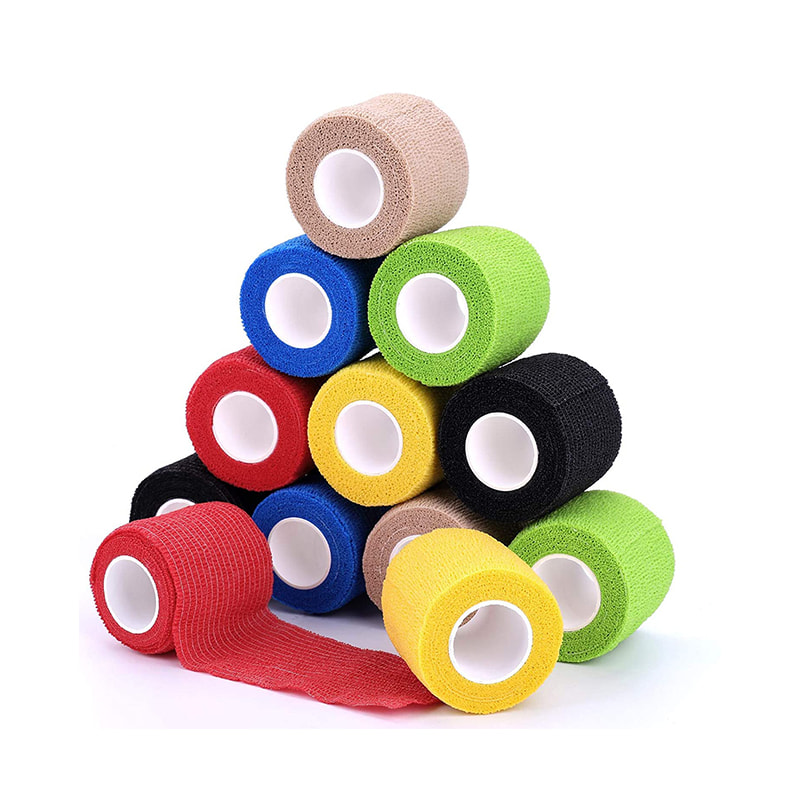
Self-adhesive cohesive bandages have become an important part of modern first-aid kits, sports-support supplies, household healthcare collections, and outdoor equipment. They combine the practical functions of a bandage wrap, a light support tape, and a convenient fastening material in one flexible product. The camouflage self-adhesive cohesive bandage described in this article is designed for camping, fishing, sporting activities, pet care, travel, promotional programs, and general first-aid applications. Its distinctive camouflage appearance gives it a practical outdoor identity, while its cohesive construction allows it to remain securely wrapped without clips, pins, or separate fasteners.
Unlike conventional adhesive tapes, this type of cohesive bandage is designed to adhere to itself rather than directly to skin or hair. This difference provides a comfortable and convenient experience for users who need to wrap a finger, wrist, ankle, elbow, knee, toe, or other body area. It can also be used over a dressing, gauze pad, or wound-contact material to help hold that material in position. Because the wrap does not normally bond to skin or hair, it can be removed and replaced more easily than many traditional adhesive products.
The product is identified as model DC660028 and is made from non-woven material. It is available in camouflage and assorted colors, with size options including 2.5 cm, 5 cm, 7.5 cm, and 10 cm widths by 4.5 meters in length. A wider specification of approximately 3 inches by 5 yards is also available according to the product configuration, and customized dimensions can be discussed for specific customer requirements. The wrap may also be printed with different patterns, making it suitable for promotional campaigns, sports teams, outdoor retailers, and private-label programs.
What Is a Self-Adhesive Cohesive Bandage?
A self-adhesive cohesive bandage is a stretchable wrap that bonds to itself when layered. It is sometimes called cohesive tape, self-adherent wrap, self-adhesive bandage, or conforming wrap. The term “cohesive” describes the way the material holds together through contact between overlapping layers. Unlike ordinary medical adhesive tape, it is not primarily intended to stick to the skin. Instead, it forms a stable outer wrap around a dressing, joint, limb, or support area.
This construction addresses several limitations associated with standard tapes and elastic bandages. Ordinary elastic bandages often require clips, hooks, or pins. Adhesive tapes may leave residue, pull body hair, or cause discomfort when removed. A cohesive wrap can be torn or cut to the required length, wrapped around the selected area, and secured by pressing the final layer against the preceding layer. This simplifies application and reduces the number of accessories needed.
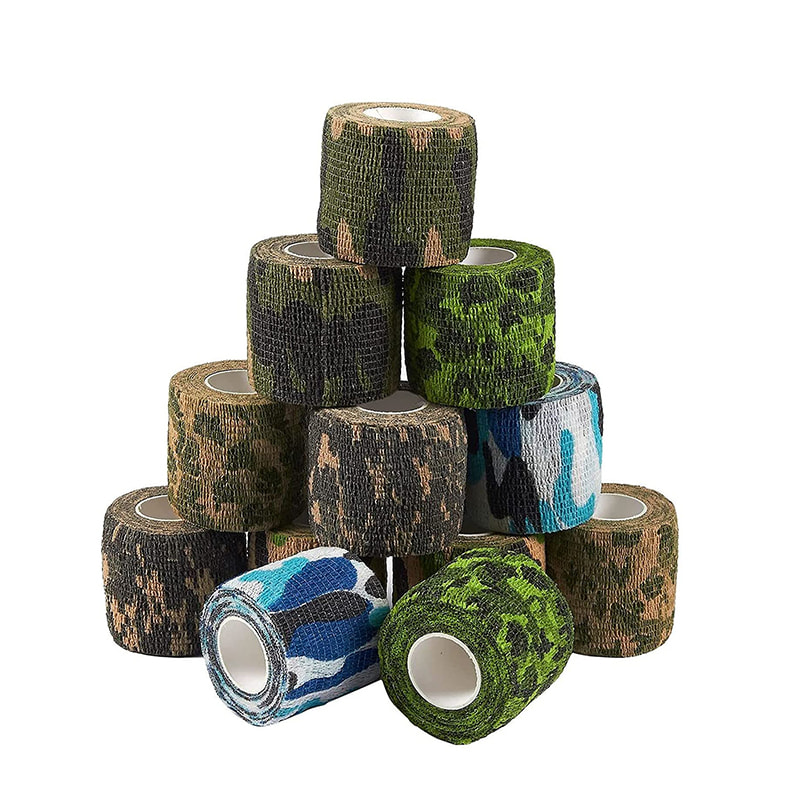
The camouflage version adds a visually distinctive pattern to the functional design. The appearance is especially suitable for camping, fishing, hunting-related outdoor recreation, hiking, field sports, and other activities where users may prefer a rugged or natural visual style. For retailers, the pattern can help separate the product from plain white or beige bandages and may increase its appeal as an outdoor first-aid accessory.
Product Overview
Model DC660028 is a non-woven self-adherent bandage wrap designed for flexible, multipurpose use. Its core function is to provide a convenient method for wrapping and supporting selected areas without requiring separate clips or pins. It can be carried in a first-aid kit, backpack, tackle box, vehicle emergency kit, gym bag, home medicine cabinet, or professional supply cabinet.
| Item | Product Information |
|---|
| Product type | Self-adhesive cohesive bandage wrap |
| Model | DC660028 |
| Material | Non-woven |
| Available colors | Camouflage and assorted colors |
| Width options | 2.5 cm, 5 cm, 7.5 cm, and 10 cm |
| Length | Approximately 4.5 meters; a 3-inch by 5-yard configuration is also referenced |
| Quantity | One roll per listed unit |
| Application method | Wrap around the target area and overlap the layers |
| Adhesion principle | Adheres to itself rather than directly to skin or hair |
| Customization | Custom sizes and printed patterns may be available |
| Typical applications | First aid, sports support, outdoor activities, pet care, promotional programs, and household use |
The range of widths makes the product adaptable to different applications. A narrow 2.5 cm roll may be more convenient for fingers, toes, or small areas. A 5 cm roll may suit wrists, hands, or compact support applications. Wider 7.5 cm and 10 cm versions can cover larger areas such as knees, elbows, ankles, or portions of the lower leg. Selecting the proper width can improve wrapping efficiency and help users control the amount of material used.
Camouflage Self Adhesive Cohesive Bandage for Camping Fishing
Key Advantage: Adhesion Without Direct Skin Bonding
The principal advantage of this cohesive bandage is its self-adhering structure. The wrap is engineered to grip overlapping layers of itself while avoiding the type of direct skin adhesion associated with ordinary adhesive tape. This makes the product particularly useful when a user wants secure positioning but also wants convenient removal and replacement.
Because the material does not normally stick to hair, it can be more comfortable for users with hairy arms or legs. It can also be helpful when a bandage needs to be changed frequently. A caregiver can loosen and remove the outer wrap without repeatedly pulling an adhesive strip from the skin. This feature is valuable in household first aid, sports sidelines, veterinary care, and situations where the wrapped area must be inspected regularly.
The self-adherent format also eliminates the need for metal clips, plastic fasteners, or pins. Separate fasteners can be lost in a first-aid kit, misplaced during outdoor activities, or applied incorrectly. With cohesive bandage, the final overlapping section can hold the wrap in place when the material is applied properly. This makes the product compact, simple, and efficient for users who need a quick wrapping solution.
It is important to understand that cohesive adhesion depends on correct application. The wrap should overlap itself, and the user should avoid excessive tension. The product is a support and securing wrap, not a substitute for professional diagnosis, wound treatment, or immobilization where a serious injury is suspected. For open wounds, an appropriate sterile dressing should be placed between the wound and the cohesive wrap.
Flexible Support for Multiple Body Areas
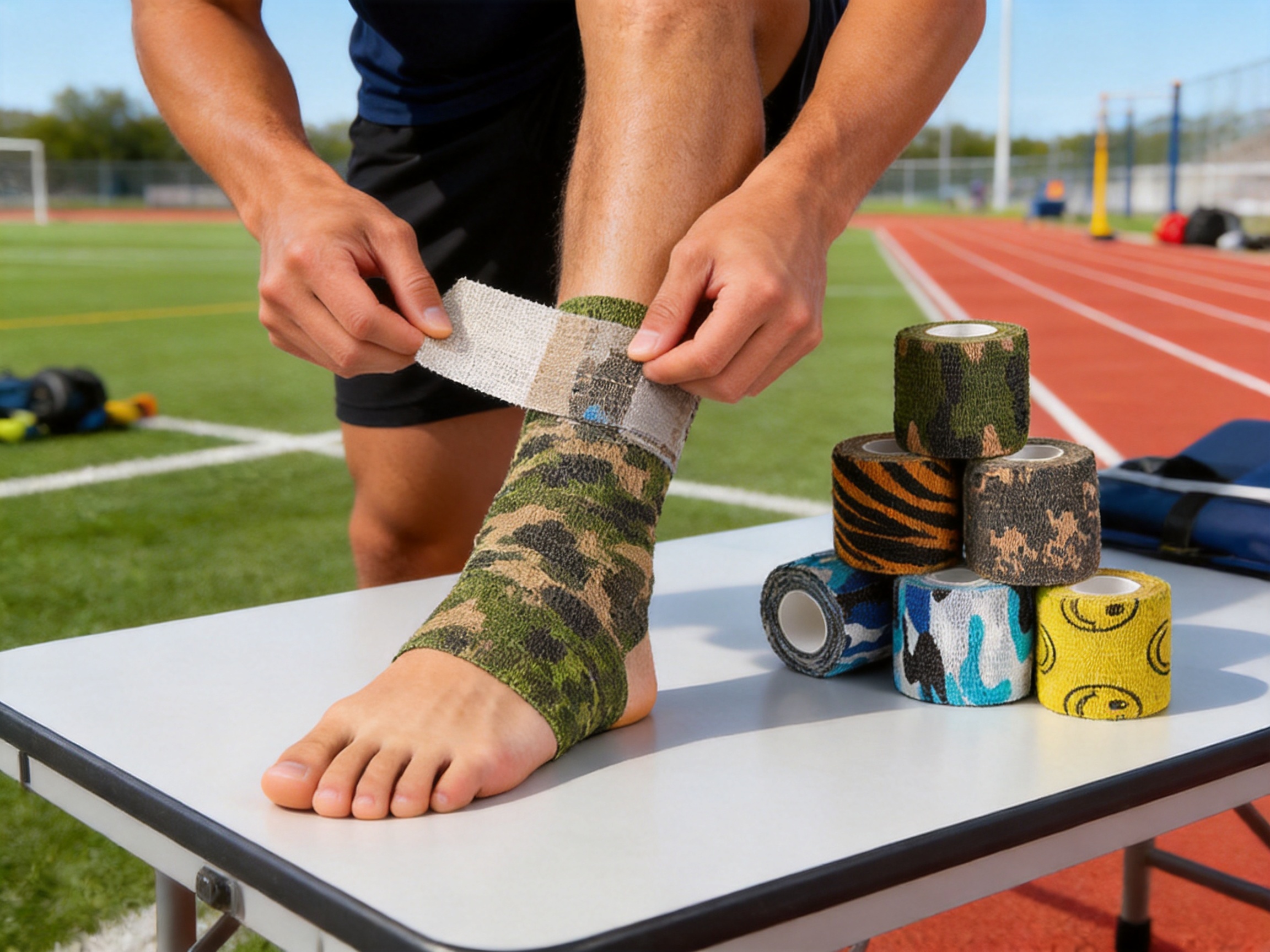
The bandage wrap can be used around the ankle, wrist, finger, toe, elbow, and knee. These areas often require a flexible material because they move during daily activity. A rigid or excessively adhesive product may restrict movement or become uncomfortable when the joint bends. A soft non-woven cohesive wrap can conform to contours and maintain a neat outer layer when applied with suitable tension.
For a wrist, the wrap can be positioned around the joint or over a dressing. For an ankle, it may help retain a pad or provide light external support during routine activity. Around a finger or toe, a narrow width can be easier to control. For a knee or elbow, a wider roll can cover the joint with fewer turns. The product should always be applied according to the intended use, and users should monitor circulation, comfort, swelling, numbness, color changes, or other warning signs.
In sports environments, cohesive bandage is frequently valued for its quick application. Athletic trainers, coaches, players, and recreational users may need to secure a cold pack cover, hold a protective pad, or create a temporary outer wrap. The camouflage print can also coordinate with outdoor uniforms, team themes, or adventure equipment.
Outdoor Applications for Camping and Fishing
Camping and fishing expose users to environments where minor cuts, abrasions, blisters, sprains, and skin irritation may occur. A compact cohesive bandage can be included in an outdoor first-aid kit without taking up much space. It can be used to secure a gauze pad, cover a dressing, hold a protective layer over a minor injury, or wrap a finger after handling equipment.
Fishing activities can involve hooks, line, knives, bait tools, rough surfaces, and prolonged handling of equipment. A self-adherent wrap can be useful when a small dressing needs to remain in place during an outdoor trip. Its ability to adhere to itself means that the user does not need to carry separate clips or adhesive strips. The camouflage design is also visually appropriate for outdoor recreation and may appeal to fishing stores, camping retailers, and sporting-goods distributors.
For camping, the product can be stored in a dry pouch, emergency kit, or personal care bag. It can be used for temporary support after minor twists, although persistent pain or suspected fractures require professional medical attention. It may also be useful for securing a protective dressing when access to a pharmacy or clinic is limited. Outdoor users should remember that the wrap itself is not a sterile wound dressing unless supplied and labeled as sterile. The wound should be cleaned and covered with a suitable dressing before the cohesive bandage is applied.
The camouflage appearance can have a practical retail advantage. Many first-aid wraps are supplied in plain colors that communicate clinical use but may not attract outdoor consumers. A patterned wrap can be displayed alongside camping gear, fishing tools, hiking equipment, and travel accessories. It can also be offered as an add-on product in outdoor emergency kits.
Use in Sports and Athletic Support
Sports support is one of the most important application categories for self-adherent bandages. Athletes often need products that are quick to apply, lightweight, flexible, and easy to remove. A cohesive wrap can be used to hold a non-stick pad in place, secure padding, cover a finger, or provide a light external layer around a joint.
The product may be suitable for training centers, gyms, school sports programs, professional clubs, sports retailers, and event organizers. Its range of widths supports different athletic applications. Narrow rolls can be useful for fingers and toes, while medium and wide rolls may be selected for wrists, ankles, knees, or elbows.
Compared with ordinary elastic bandages, self-adherent cohesive wraps can reduce setup time because separate clips are not needed. Compared with direct adhesive tapes, they can be easier to remove and may cause less pulling of body hair. Compared with plain clinical wraps, camouflage printing can provide a more distinctive appearance for teams, outdoor athletes, and promotional events.
However, a cohesive bandage should not be presented as a treatment for structural injuries or as a replacement for professional athletic taping when a high level of mechanical support is necessary. Its value is in convenient wrapping, retention, light support, and protective coverage. The appropriate amount of tension should be used, and the wrapped area should be checked regularly during activity.
Pet Care Applications
The product description also identifies use on pets. Veterinary and pet-care applications may include securing a dressing, covering a minor protective pad, or helping keep a bandage in position after professional treatment. The self-adherent design can be useful because it avoids direct adhesive contact with fur in the same way that it avoids sticking to human hair.
Pet owners should use caution. Animals may chew or pull at a wrap, and a bandage that is too tight can impair circulation. The product should never be applied as a substitute for veterinary advice. A veterinarian should determine whether a wound requires cleaning, suturing, medication, drainage, or a specialized dressing. When a cohesive wrap is used, it should be applied under appropriate guidance and checked frequently.
For veterinary clinics, animal shelters, grooming businesses, and pet retailers, camouflage patterns may have strong visual appeal. The wrap can be included in pet first-aid kits or sold as a practical accessory for outdoor dogs and working animals. The non-woven construction and self-adherent format can support convenient application where fur makes ordinary adhesive tapes difficult to use.
Non-Woven Material and User Experience
Model DC660028 is made from non-woven material. Non-woven fabrics are manufactured by arranging and bonding fibers rather than weaving them into a conventional over-and-under textile structure. This production approach can provide a soft, lightweight, and conformable substrate for disposable or semi-disposable medical and healthcare products.
For a cohesive bandage, the material must balance several performance characteristics. It should be sufficiently flexible to wrap around curved body areas. It should have enough integrity to remain together during application. It should allow the user to tear or cut the roll to a practical length. It should also support consistent contact between overlapping layers so that the wrap remains in place.
The user experience is influenced by width, roll length, stretch behavior, surface texture, pattern printing, and packaging. A well-prepared roll should unwind smoothly and permit controlled application. Consistency is particularly important for distributors and institutional buyers, who need products that perform similarly from one batch to another.
Non-woven material can also support efficient customization. Different colors and printed patterns may be produced for customer-specific programs. The camouflage design may be retained as a standard product style, while other patterns can be developed for sports teams, retail campaigns, promotional events, or private-label healthcare ranges.
Printing and Promotional Potential
The product can be printed with different patterns, which creates a useful commercial advantage over unprinted bandages. Pattern printing allows the wrap to become more than a basic medical consumable. It can function as a promotional item, a branded retail accessory, or a themed component of a first-aid kit.
Outdoor companies may choose nature-inspired patterns. Sports teams may request colors associated with their uniforms. Retailers may prefer seasonal designs. Event organizers can use printed cohesive bandages in participant kits or promotional packages. The product can also be customized for distributors that want a distinctive appearance without changing the basic function of the wrap.
Pattern printing must be managed carefully so that visual design does not compromise product performance. Ink selection, print registration, color consistency, and surface compatibility all matter. A professional manufacturing process should control the relationship between the printing stage and the cohesive performance of the material. The final product should remain easy to apply, easy to identify, and reliable in normal use.

Comparison with Competing Bandage Formats
Self-adherent cohesive bandages compete with several different product categories, including ordinary adhesive tape, gauze rolls, elastic bandages with clips, tubular supports, and pre-cut adhesive bandages. Each format has a valid purpose, but the cohesive wrap offers a distinctive combination of flexibility, convenience, and self-securing performance.
| Product format | Typical fastening method | Primary strengths | Potential limitations compared with cohesive wrap |
|---|
| Self-adhesive cohesive bandage | Adheres to overlapping layers of itself | Quick application, no clips or pins, easy removal, flexible, suitable for many body areas | Requires correct overlap and controlled tension |
| Ordinary adhesive tape | Direct adhesive contact with skin or dressing | Strong attachment to selected surfaces | May leave residue, pull hair, or be uncomfortable during removal |
| Gauze roll | Usually secured with tape, clips, or a knot | Useful for dressing and padding applications | May need a separate fastening product |
| Elastic bandage with clips | Clips, hooks, or fasteners | Adjustable compression and broad coverage | Clips can be lost, and application may take longer |
| Tubular support | Elastic tension around the body area | Simple sleeve-like application | Less adaptable to irregular shapes and dressing retention |
| Pre-cut adhesive bandage | Adhesive wings around a wound pad | Convenient for small, localized wounds | Limited size, shape, and support options |
The competitive advantage of DC660028 is not that it replaces every other bandage format. Instead, it fills a flexible middle position. It can act as an outer retention layer, a light support wrap, or a quick emergency bandage accessory. It is more adaptable than a pre-cut adhesive bandage and more self-securing than a basic gauze roll. Compared with a conventional elastic wrap, it removes the need for clips or pins. Compared with direct adhesive tape, it offers a different removal experience because it is designed to adhere to itself.
The camouflage pattern provides another point of differentiation. Many competing products are available only in plain white, beige, or neutral colors. A camouflage design may be more attractive to consumers who participate in camping, fishing, hiking, hunting-related recreation, outdoor work, or field sports. For wholesalers and retailers, the visual design can help create a recognizable product line.
Manufacturing Expertise and Quality Focus
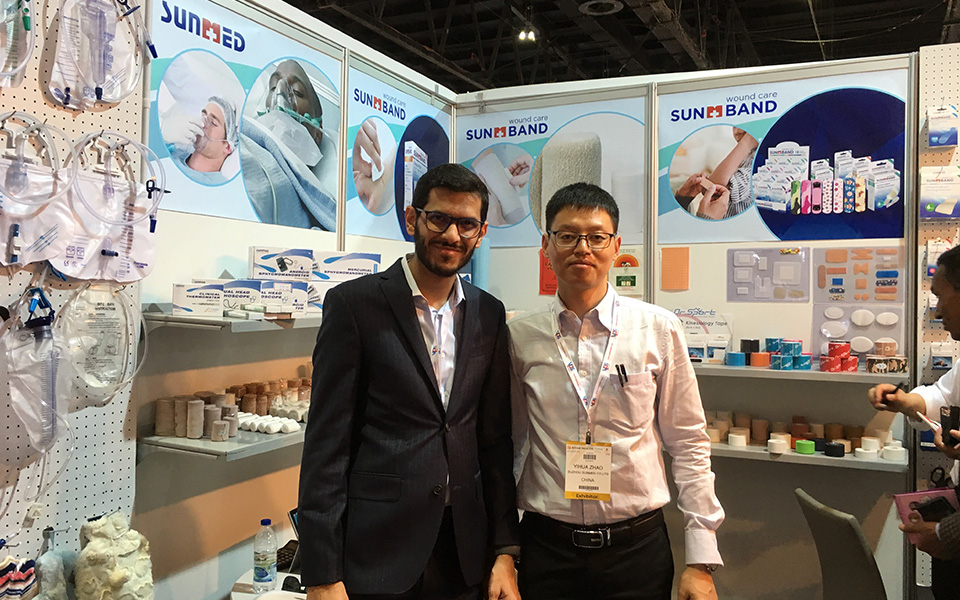
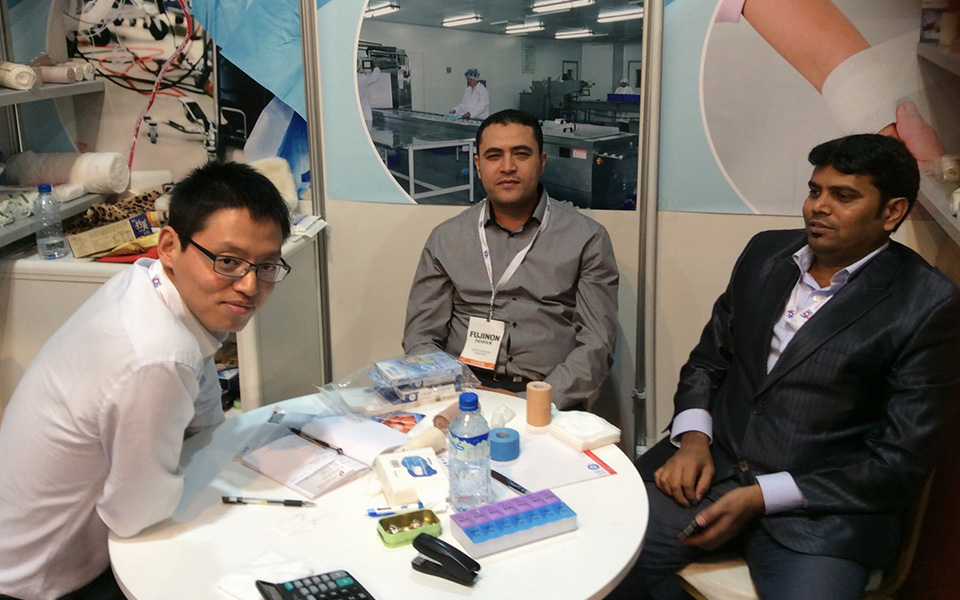
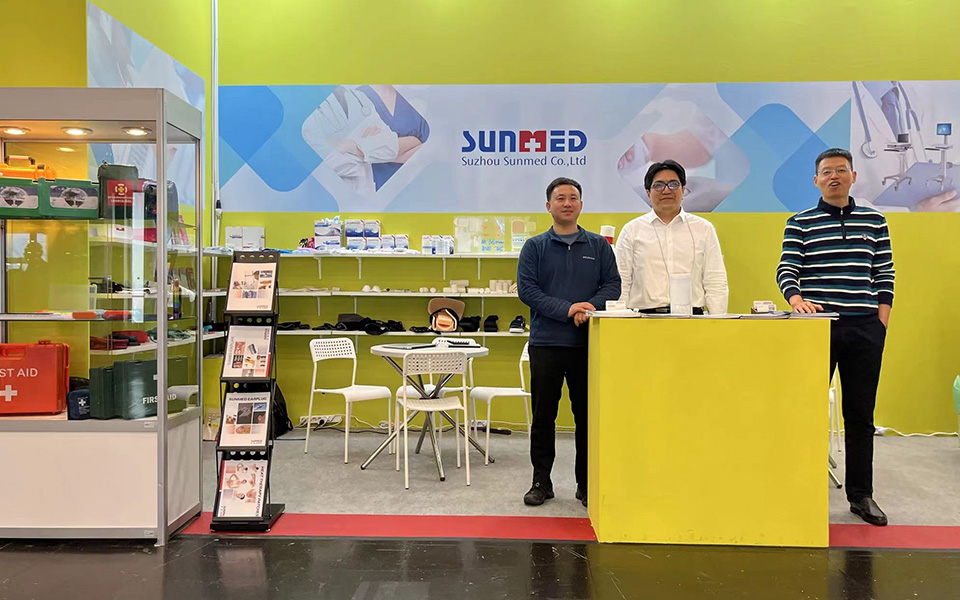
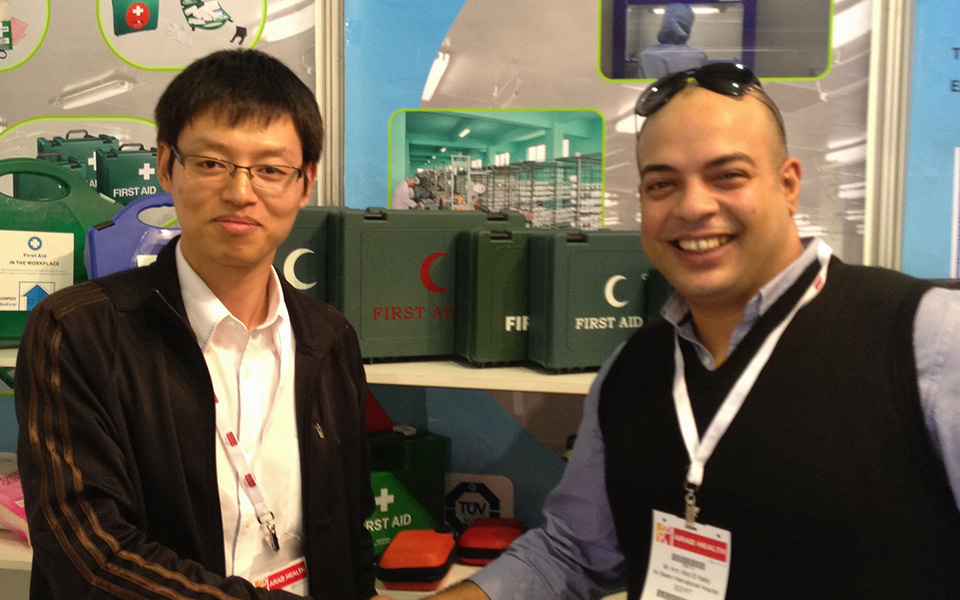
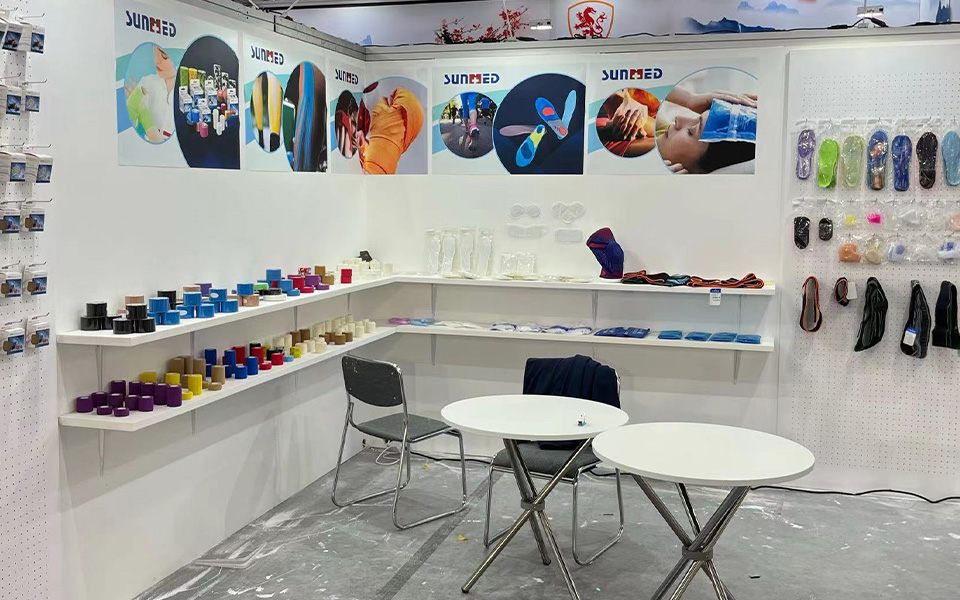
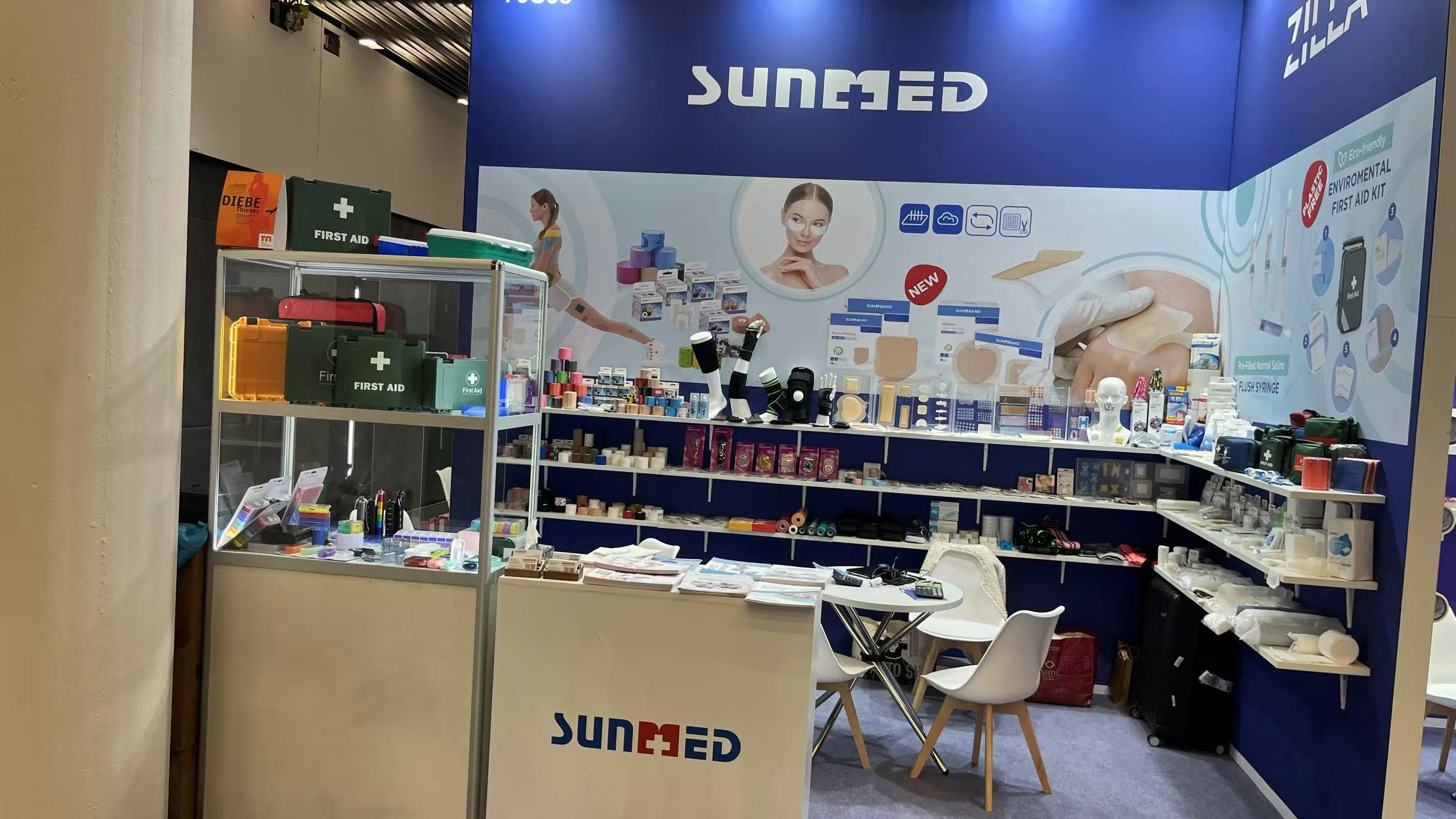
Suzhou Sunmed Co., Ltd. is described as a professional manufacturer and exporter of first-aid, medical, and healthcare products in China. The company operates production bases in Jiangsu, Zhejiang, and Anhui Province and reports approximately 30 years of experience in the medical device, medical equipment, and medical consumables industry.
The company’s product expertise covers first-aid products, wound dressings, medical gauze, bandages, medical tape, medical cotton, non-woven products, sports bandages, kinesiology tape, pill boxes, hot and cold packs, medical instruments, disposable syringes, catheters, surgical consumables, and other healthcare products. This broad product base is relevant to cohesive bandage manufacturing because it reflects experience with different materials, converting processes, packaging requirements, and healthcare distribution channels.
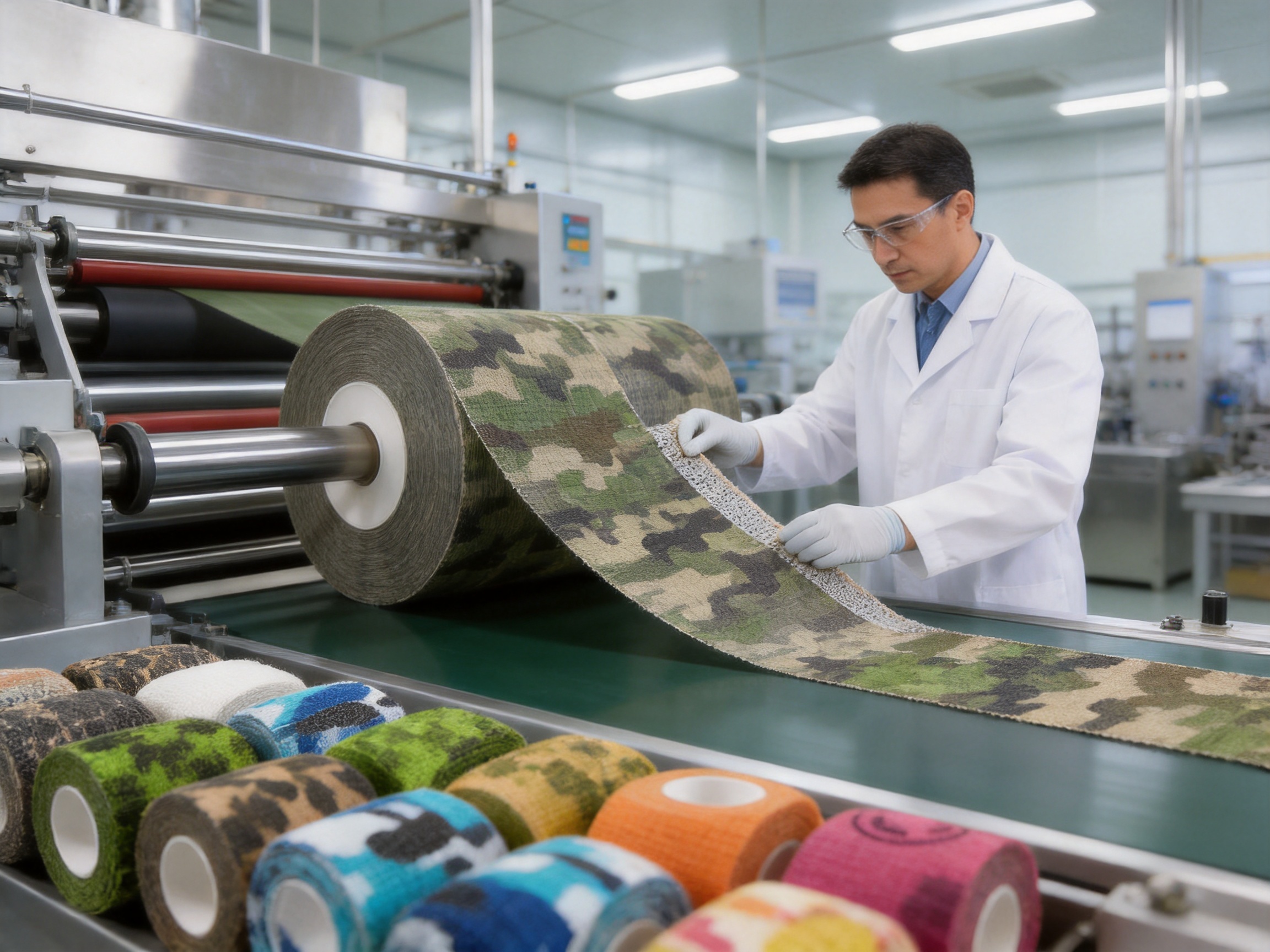
According to the supplied company information, the business established its first-aid factory in 2008 to meet customer demand. In 2021, it established a dedicated factory for kinesiology tape, cohesive bandages, and elastic adhesive bandages. A dedicated manufacturing base can support focused process management for products that require controlled coating, bonding, slitting, rolling, printing, inspection, and packaging operations.
Manufacturing strength is especially important for self-adherent bandages because the product must achieve a careful balance. If the cohesive effect is too weak, the wrap may loosen during use. If it is too strong or inconsistent, application and removal may be difficult. If the material tears irregularly, users may waste product or have trouble obtaining a neat finish. If the roll tension varies, the product may unwind unevenly. Consistent production controls help address these concerns.
Advanced Manufacturing Process
The exact proprietary production parameters for DC660028 are not publicly specified in the supplied material. Nevertheless, a professional cohesive bandage production process generally includes several controlled stages. These stages can be organized from raw-material preparation through final inspection and shipment.
Raw-Material Selection
The first stage is the selection and verification of the non-woven substrate and cohesive components. The substrate must provide suitable softness, flexibility, strength, and dimensional stability. Materials are normally assessed according to supplier documentation, incoming inspection criteria, and customer specifications.
For a printed camouflage product, the printing materials must also be compatible with the non-woven surface and the intended product application. Color matching and pattern consistency are important for commercial presentation. Raw materials should be stored under appropriate conditions to protect them from moisture, contamination, and avoidable damage.
Substrate Preparation
The non-woven material may be supplied in large master rolls. Before coating or converting, the substrate can be inspected for visible defects, uneven areas, edge damage, or dimensional variation. Proper web handling helps maintain uniform production and reduces wrinkles or misalignment.
Substrate preparation may include surface treatment or conditioning when necessary for the intended cohesive layer or printing process. The goal is to ensure that later operations are stable and repeatable across the width and length of the material.
Cohesive Layer Application
A cohesive bandage requires a self-adherent surface system that bonds to itself when layers overlap. The cohesive component must be applied evenly enough to support consistent performance throughout the roll. Coating control may involve monitoring application quantity, web speed, temperature, pressure, and drying or curing conditions, depending on the material system used.
Uniformity in this stage directly affects the product’s competitive performance. A roll with excessive variation may feel different from one section to another. Consistent coating supports predictable adhesion, smooth unwinding, and reliable retention. Manufacturing teams may use process records and sampling inspections to confirm that the product remains within established requirements.
Pattern Printing
Camouflage printing may be performed before or after selected converting stages, depending on the product design and production line. Printing equipment must maintain accurate registration so that the pattern appears consistent along the roll. The process should also protect the cohesive function of the bandage.
Different printed patterns can be introduced through controlled artwork, color specifications, and approved samples. For customized programs, the manufacturer may coordinate design confirmation, sample approval, production scheduling, and packaging artwork. This offers buyers a structured route from a standard camouflage product to a customized promotional or private-label version.
Slitting and Width Conversion
Large master rolls are converted into the required widths, such as 2.5 cm, 5 cm, 7.5 cm, or 10 cm. Slitting accuracy is important because the final width affects application, packaging, and customer expectations. Clean edges help the roll look professional and make it easier to use around small or curved body areas.
A capable converting operation should control blade condition, web alignment, roll tension, and finished-roll dimensions. These controls help prevent uneven edges, telescoping rolls, loose winding, and inconsistent lengths. Width conversion also enables the same basic material platform to serve different markets and application needs.
Rolling and Core Assembly
After slitting, the bandage material is wound into individual rolls. Roll density and tension must be managed carefully. A roll that is too loose may deform or unwind unexpectedly, while a roll that is too tight may be difficult to pull and apply. Proper winding supports stable storage, efficient packaging, and a consistent user experience.
The roll may be assembled with an internal core or another suitable structure, depending on packaging requirements. Finished rolls are checked for visual appearance, winding quality, pattern consistency, and labeling accuracy before they move to final packaging.
Packaging and Identification
Packaging protects the roll during handling, transportation, storage, and retail display. It should identify the model, dimensions, material, color, quantity, and relevant usage information. For customized orders, packaging may include customer-approved artwork, product codes, barcodes, or language-specific instructions.
Clear identification reduces confusion between different widths and patterns. It also helps warehouse teams, distributors, retailers, and end users select the correct specification. A professional packaging system should support traceability through batch or lot information where applicable.
Quality Control and Regulatory Awareness
The supplied company information states that Sunmed has a professional quality-control team comprising hundreds of personnel and that its inspection procedures are designed to support ISO 13485:2016 standards. It also states that most products are CE certified and that the Suzhou factories comply with FDA requirements. Buyers should verify the specific certification, registration, intended use, and market requirements applicable to the exact DC660028 configuration before placing an order or selling the product in a particular jurisdiction.
Quality control for a cohesive bandage may include inspection of raw materials, dimensional checks, visual checks, roll-length verification, packaging review, and assessment of cohesive performance. Depending on the product classification and market, additional testing may be appropriate. The exact test program should be agreed between the manufacturer and customer based on the intended use and applicable regulations.
Visual inspection can identify printing defects, contamination, edge damage, irregular winding, or packaging problems. Dimensional inspection confirms whether width and length meet the required specification. Performance evaluation can examine whether overlapping layers adhere adequately, whether the product can be removed as intended, and whether the wrap maintains integrity during normal handling.
Quality management is not limited to final inspection. It includes supplier control, documented procedures, equipment maintenance, staff training, process monitoring, nonconformance handling, corrective action, and traceability. A manufacturer with experience across medical consumables is better positioned to integrate these activities into a repeatable production system.
Customization for Wholesale and Private-Label Buyers
One of the product’s commercial strengths is its customization potential. The available width options already allow buyers to select a configuration for different sales channels. In addition, the bandage can be printed with different patterns, and the supplied information indicates that custom dimensions are possible.
Wholesale customers may request assorted colors to create a broader product range. Outdoor retailers may prefer camouflage as the main visual identity. Sports distributors may request team-oriented colors. First-aid kit assemblers may select a width and packaging style that fits an existing kit format. Promotional-product companies may want a printed design for a campaign or event.
Customization should be handled through a clear approval process. The buyer and manufacturer should confirm the required width, length, material, color, pattern, print area, packaging, labeling, quantity, and delivery schedule. Samples or pre-production approvals can reduce the risk of artwork or specification differences.
For private-label programs, product documentation and packaging content should be reviewed carefully. Depending on the destination market, labeling may need to address intended use, precautions, storage, manufacturer information, lot identification, and regulatory statements. Customers should provide their market-specific requirements early in the purchasing process.
Distribution and Market Applications
DC660028 can serve several distribution channels. Hospitals and clinics may use cohesive wraps for selected non-sterile support or retention applications. First-aid suppliers can include them in emergency kits. Supermarkets and pharmacies may sell them in household healthcare sections. Sports shops can position them with athletic support products. Outdoor retailers can merchandise the camouflage version with camping and fishing accessories.
Veterinary suppliers, pet retailers, and animal-care businesses may also find the product relevant. Travel-kit manufacturers and workplace first-aid providers can use it as a compact wrapping component. Because the product can be produced in different widths and patterns, it can support both general-purpose and niche retail programs.
The company reports exporting products to more than 60 countries, including markets in Europe, Southeast Asia, Africa, and Oceania. This international experience may assist customers with communication, product coordination, export documentation, and familiarity with different distribution environments. Buyers should still confirm the specific compliance requirements for their country and product application.
Recommended Application Method
Before application, inspect the roll and confirm that the intended body area is clean and dry. If a wound is present, apply an appropriate wound dressing first. Do not place a non-sterile cohesive wrap directly over an open wound unless the product is specifically labeled for that use.
Unroll a suitable length and begin wrapping with moderate tension. Allow each layer to overlap the previous layer so that the cohesive surfaces contact one another. Continue until the dressing or support area is adequately covered. Press the final section gently against the underlying layer to help secure it.
The wrap should be supportive but not excessively tight. Check the exposed fingers or toes where possible and monitor for numbness, tingling, unusual coldness, discoloration, increased pain, or swelling. If these symptoms appear, remove or loosen the wrap and seek appropriate medical advice. Replace the bandage if it becomes wet, dirty, damaged, or loose.
When removing the wrap, unwind it carefully or cut it away with appropriate caution. Avoid using sharp instruments near skin unless necessary and controlled. Because the product is designed to adhere to itself rather than hair or skin, removal may be simpler than with many direct adhesive products, but users should still proceed gently.
Safety and Responsible Use
A cohesive bandage is a healthcare accessory, not a universal treatment. It can help secure a dressing or provide light support, but it does not diagnose injuries, stop severe bleeding by itself, repair fractures, or replace professional care. Severe bleeding, deep wounds, animal bites, suspected fractures, dislocations, serious burns, loss of sensation, or persistent swelling require medical evaluation.
Users should avoid applying the wrap too tightly. The camouflage appearance should not lead users to overlook circulation checks or wound monitoring. Children should use the product under adult supervision. Pets should be monitored to prevent chewing, ingestion, or overly tight application.
Storage should follow the product label and supplier instructions. In general, medical consumables should be protected from excessive heat, moisture, direct sunlight, contamination, and physical damage. Retail and warehouse teams should rotate stock appropriately and inspect packaging before distribution.
Why This Product Is a Strong Competitive Choice
The camouflage self-adhesive cohesive bandage combines several features that are valuable in competitive healthcare and outdoor-accessory markets. Its self-adherent construction simplifies fastening. Its non-woven substrate supports flexibility and comfortable wrapping. Its range of sizes supports different body areas. Its camouflage pattern differentiates it visually. Its printing capability creates promotional opportunities. Its suitability for people and pets broadens the potential customer base.
Compared with a basic gauze roll, it offers integrated self-securing capability. Compared with an ordinary adhesive tape, it is designed to avoid direct bonding to skin and hair. Compared with an elastic bandage that requires clips, it reduces the number of separate components. Compared with a plain wrap, it offers a distinctive outdoor-oriented design.
The product is also supported by the manufacturing capabilities of Suzhou Sunmed Co., Ltd., including long-term experience in medical consumables, dedicated production facilities for cohesive and related bandages, a broad export background, and a stated focus on quality-management procedures. These strengths can be particularly valuable to wholesale buyers that require stable supply, product customization, and coordinated communication.
Procurement Considerations for Buyers
Before purchasing, buyers should identify the intended market and application. A sports shop may need attractive packaging and several widths. A hospital distributor may require detailed technical files and specific compliance documents. An outdoor retailer may focus on camouflage design, compact packaging, and promotional presentation. A first-aid kit assembler may prioritize roll dimensions and efficient packing.
Buyers should confirm whether the required length is 4.5 meters or approximately 5 yards, since these descriptions are close but should be specified accurately in a purchase order. Width, color, print pattern, packaging format, quantity per carton, and customization requirements should also be documented.
It is useful to request product samples before large-scale purchasing. Samples allow buyers to evaluate unwinding, stretch, cohesive performance, edge quality, print appearance, packaging, and ease of application. For private-label programs, artwork approval and a written specification can help prevent misunderstandings.
Purchasers should also confirm the product’s intended regulatory classification and any applicable declarations or certificates. Certification claims should be matched to the exact product, factory, market, and intended use. Importers and distributors remain responsible for ensuring that the product meets the rules applicable in their destination market.
Q&A
What is the main purpose of this camouflage bandage?
The main purpose is to wrap and support selected body areas, secure dressings, and provide a convenient self-adherent outer layer. It is suitable for first aid, sports support, camping, fishing, travel, pet care, and household healthcare applications.
Does the bandage stick directly to skin?
The product is designed to adhere to itself rather than directly to skin or hair. This helps make application and removal more convenient. Users should still apply it carefully and follow the product instructions.
Can it be used without clips or pins?
Yes. Its cohesive construction allows overlapping layers to hold together, so separate clips or pins are generally not required when the wrap is applied correctly.
What sizes are available?
The listed size options include widths of 2.5 cm, 5 cm, 7.5 cm, and 10 cm, with a length of approximately 4.5 meters. The product information also references a 3-inch by 5-yard configuration. Buyers should confirm the exact specification before ordering.
Is the product suitable for sports?
Yes. It can be used for athletic support, dressing retention, light wrapping, and securing protective pads. It should not be considered a substitute for professional evaluation or specialized immobilization when a serious injury is suspected.
Can it be used on pets?
The product description identifies pet use as one of its applications. Pet owners should apply it cautiously, avoid excessive tension, monitor circulation, and seek veterinary advice for wounds or injuries.
Can the pattern be customized?
The product can be printed with different patterns, and the camouflage design is one available style. Buyers should discuss artwork, colors, dimensions, packaging, minimum order quantities, and sampling requirements with the manufacturer.
Is the bandage sterile?
The supplied product information does not state that this particular wrap is sterile. Buyers should confirm sterility status directly with the manufacturer. Unless clearly labeled otherwise, it should be treated as a non-sterile outer wrap and used over an appropriate dressing.
Who manufactures model DC660028?
Model DC660028 is supplied by Suzhou Sunmed Co., Ltd., a Chinese manufacturer and exporter of first-aid, medical, and healthcare products.
What makes the camouflage design commercially useful?
The camouflage pattern differentiates the product from plain medical wraps and connects it with outdoor recreation, camping, fishing, sports, travel, and promotional programs. It may help retailers create a more distinctive product display.
How should the wrap be applied?
Place it over a suitable dressing or around the intended support area, overlap each layer, and secure the final section against the underlying wrap. Apply moderate tension and monitor circulation and comfort.
What should buyers confirm before placing an order?
Buyers should confirm width, length, material, color, pattern, packaging, quantity, labeling, customization, delivery schedule, regulatory documentation, and the precise intended use.
Conclusion
The camouflage self-adhesive cohesive bandage for camping and fishing is a versatile medical consumable with strong potential in first aid, sports support, outdoor recreation, pet care, and promotional markets. Its most important functional advantage is the ability to adhere to itself without requiring clips or pins, while avoiding the direct skin and hair adhesion associated with conventional adhesive tape.
Its non-woven construction, multiple width options, customizable dimensions, and printed-pattern capability make it adaptable for both general and specialized applications. The camouflage appearance adds a strong outdoor identity and provides a clear point of difference for retailers and wholesalers.
Behind the product is Suzhou Sunmed Co., Ltd., a manufacturer with reported experience across first-aid products, wound care, medical tapes, bandages, non-woven products, sports supports, and other healthcare supplies. The company’s dedicated production activity for cohesive bandages and related products, international export experience, and stated quality-management focus can support buyers seeking a reliable OEM or wholesale partner.
For responsible use, the bandage should be applied with appropriate tension, used over a suitable dressing when required, and removed or replaced when damaged or soiled. When purchased with confirmed specifications and used correctly, DC660028 can provide an efficient, attractive, and practical wrapping solution for healthcare, athletic, outdoor, and promotional product programs.
References
1. Product specification supplied for model DC660028, camouflage self-adhesive cohesive bandage wrap.
2. Manufacturer information supplied for Suzhou Sunmed Co., Ltd., including company history, production bases, product categories, export markets, and quality-management statements.
3. ISO 13485:2016, Medical devices — Quality management systems — Requirements for regulatory purposes.
4. General principles of first aid, wound dressing retention, circulation monitoring, and safe bandage application.
5. General guidance concerning medical consumable labeling, storage, traceability, and market-specific regulatory review.

 English
 Español
 русский
 Français
 Deutsch
 italiano
 By Admin