Medical adhesive tape is a fundamental component of modern healthcare. It supports dressings, secures catheters, stabilizes infusion needles, fixes tubing, and helps maintain the position of wound-care materials during treatment. Among the many medical tape materials available today, polyethylene, commonly known as PE, remains a practical and versatile choice because it combines transparency, flexibility, controlled adhesion, easy tearing, and good permeability. When correctly designed and manufactured, PE tape can provide dependable fixation while reducing unnecessary discomfort during application and removal.
This article examines transparent medical PE tape in detail, including its material structure, product specifications, key benefits, clinical applications, packaging options, quality considerations, and manufacturing processes. It also explains why a professionally manufactured PE tape can offer important advantages over less specialized alternatives, especially in terms of consistency, usability, customization, and supply reliability.
Understanding Transparent Medical PE Tape
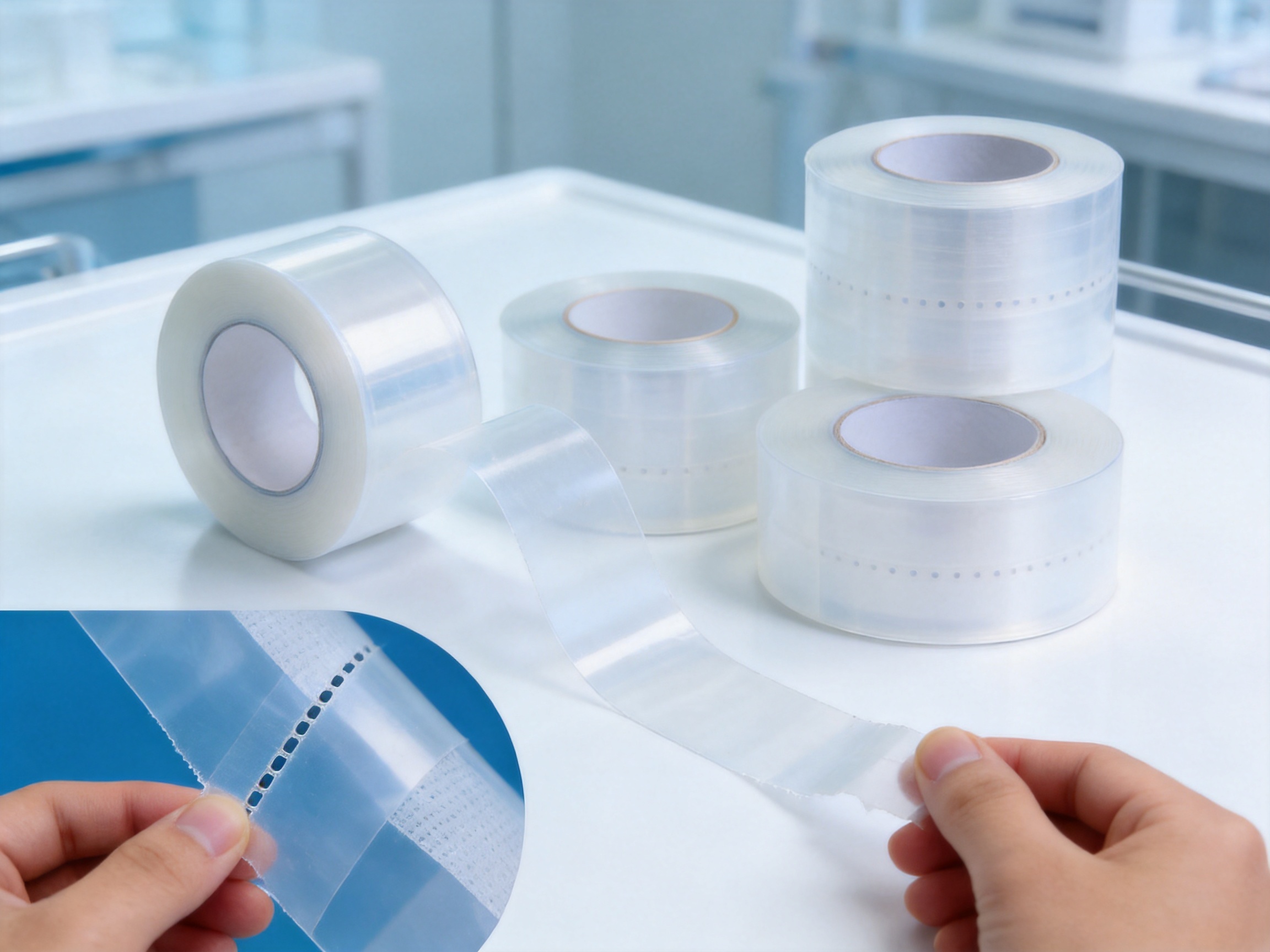
Transparent medical PE tape is a pressure-sensitive adhesive product made from a polyethylene film coated with medical-grade adhesive. The tape is supplied in rolls and may be wound around a transparent or paper inner core. Depending on the intended market and packaging requirements, it can be supplied in bulk rolls, plastic spools, blister packs, or dispensing packages.
The tape is designed for medical fixation rather than for permanent structural bonding. Its primary purpose is to hold dressings, tubes, catheters, needles, and other lightweight medical components securely in place while allowing healthcare professionals to apply, tear, adjust, and remove it efficiently.
A typical transparent PE tape consists of three main functional elements:
A polyethylene film backing that provides flexibility, support, and a smooth surface.
A medical pressure-sensitive adhesive layer that bonds to the skin or dressing without requiring heat, water, or solvent activation.
An inner core and external packaging system that protect the roll and support convenient dispensing.
Some product versions include evenly distributed perforations. These microperforations improve breathability and help users tear the tape by hand in both directions. The perforated structure also allows air and water vapor to pass through more easily than an entirely impermeable film, supporting greater comfort during extended wear.
PE tape is generally transparent or translucent, although color options such as blue may also be produced. A glossy or matte surface can be selected according to product positioning, packaging style, and user preference.
Core Product Specifications
The product range represented by codes SMD-250201 through SMD-250204 is designed around common medical tape widths and retail or institutional packaging requirements. The principal dimensions include half-inch, one-inch, two-inch, and three-inch widths, with a standard length of ten yards for the listed configurations.
| Product Code |
Description |
Approximate Metric Width |
Packaging Quantity |
| SMD-250201 |
PE tape, 1/2 inch x 10 yards |
1.25 cm |
24 pieces per box |
| SMD-250202 |
PE tape, 1 inch x 10 yards |
2.5 cm |
12 pieces per box |
| SMD-250203 |
PE tape, 2 inches x 10 yards |
5 cm |
6 pieces per box |
| SMD-250204 |
PE tape, 3 inches x 10 yards |
7.5 cm |
4 pieces per box |
Other available widths can include 10 cm, while length options may include 5 yards, 5 meters, 10 yards, and 10 meters. Customized dimensions and packaging can also be considered for distributors, hospitals, private-label brands, first-aid suppliers, pharmacies, and international healthcare companies.
The tape may be produced with different inner core options, including a transparent core or paper core. The choice depends on the customer’s packaging concept, dispensing requirements, storage conditions, and target price point. Plastic spools can be manufactured from polypropylene, polystyrene, or ABS, providing additional flexibility for different packaging programs.

PE Tape
Material Advantages of Polyethylene Film
Polyethylene is widely used in healthcare packaging, disposable medical products, and protective films because it offers a useful combination of flexibility, chemical stability, low weight, and processability. In medical tape applications, the PE film serves as a comfortable and adaptable backing that can conform to the contours of the body.
Flexibility and Conformability
The film backing can bend and flex as the patient moves. This is particularly valuable when the tape is used on areas such as the arm, hand, wrist, shoulder, chest, or leg. A rigid backing may lift at the edges or restrict movement, while a flexible PE backing can follow ordinary body motion more effectively.
Flexibility is also beneficial during application. Healthcare workers can position the tape over a dressing, catheter, or tube without needing to manipulate a stiff strip. The tape can be pressed down progressively, helping the user create more consistent contact with the skin or underlying dressing.
Lightweight Construction
PE tape is lightweight and does not add significant bulk to a dressing or medical fixation point. A low-profile tape is generally more comfortable for patients and less likely to interfere with clothing, medical equipment, or routine movement.
Transparency
The transparent appearance allows the underlying dressing, skin area, or fixation point to remain more visible. This can help healthcare professionals observe the position of the tape and identify whether an edge has lifted or whether a dressing requires attention. Transparency can also create a clean, discreet appearance in consumer first-aid products.
Perforated Breathability
Microperforated PE tape is designed to allow a high level of air and water-vapor transmission compared with a solid, nonperforated film. Breathability is important when tape remains in place for a prolonged period because it can help reduce the feeling of occlusion and support a more comfortable wearing experience.
Perforation patterns must be carefully controlled. Holes that are too large, uneven, or poorly aligned can reduce the tape’s mechanical integrity. Properly engineered perforations maintain a useful balance between breathability, tearability, and holding performance.
Easy Tearing and Efficient Clinical Use
One of the most important functional features of this PE tape is its ability to tear easily in both directions. In clinical environments, users may need to cut or tear tape quickly while wearing gloves, managing a patient, or handling other sterile or clean materials. A tape that requires scissors can slow down routine procedures and create an additional equipment dependency.
Evenly distributed holes help create a controlled tear line. The user can tear the tape across its width or along its length, depending on the application. This makes it possible to produce a short fastening strip, a longer securing strip, or a customized piece without using a separate cutting tool.
The tear line should not deform excessively during use. Excessive deformation can produce uneven edges, compromise the appearance of the dressing, or make it difficult to tear a predictable length. A well-controlled perforation process helps ensure that the tape separates cleanly while retaining sufficient strength during handling.
Easy tearing provides several practical advantages:
It supports rapid application during routine nursing procedures.
It reduces the need for scissors or dispensers at the point of care.
It allows healthcare workers to adapt the tape length to different dressing sizes.
It improves convenience in first-aid kits, ambulances, clinics, hospitals, and home-care settings.
It helps reduce handling time when multiple fixation points must be secured.
At the same time, easy tearing must not be confused with weak construction. A high-quality medical tape should tear when deliberately pulled along the perforation line but remain intact during ordinary application, transport, and use.
Medical Pressure-Sensitive Adhesive Performance
The adhesive system is central to the performance of any medical tape. A pressure-sensitive adhesive bonds when moderate pressure is applied, without the need for heat or liquid activation. In the case of PE tape, the adhesive is applied to the film backing in a controlled coating process and selected for medical fixation requirements.
A suitable adhesive should provide sufficient initial tack for positioning while also maintaining reliable adhesion during normal wear. It should bond effectively to appropriate skin surfaces, dressings, gauze, and lightweight tubing when used in accordance with the product’s intended purpose.
Medical tape adhesive must be balanced carefully. Excessive adhesion may cause discomfort during removal or increase the possibility of skin irritation, particularly for patients with fragile or sensitive skin. Insufficient adhesion may result in premature lifting, repeated reapplication, and poor fixation. The objective is controlled and dependable adhesion rather than the strongest possible bond.
Hypoallergenic Positioning
Transparent microperforated PE tape is commonly positioned as a hypoallergenic medical tape option. Hypoallergenic design aims to reduce the likelihood of allergic response compared with certain more aggressive adhesive systems. However, no adhesive can guarantee that every individual will experience no reaction. Skin condition, duration of wear, temperature, moisture, pressure, and individual sensitivity all influence tolerance.
For that reason, professional users should follow appropriate clinical procedures, observe the skin during extended use, and remove the tape carefully. Product documentation should identify the intended use, adhesive characteristics, storage requirements, and any relevant warnings.
Applications in Hospitals and Healthcare Facilities
PE tape is used across many areas of medical care because its function is simple, adaptable, and easy to integrate into existing procedures.
Catheter and Needle Fixation
The tape can be used to secure catheters and needles during infusion procedures when the selected product and clinical protocol are appropriate for the application. Its transparency allows the healthcare worker to observe the general fixation area, while its flexible backing can conform around the limb or other body surface.
When securing a catheter or needle, the tape should be applied to clean, dry skin in a manner that does not place unnecessary tension on the device. The healthcare worker should confirm that the tape does not interfere with the insertion site, flow line, connector, or observation of the area.
Dressing Fixation
PE tape can hold gauze, nonwoven dressings, absorbent pads, and other wound-care materials in position. It is suitable for applications where the dressing must remain stable but may need to be removed or replaced during follow-up care.
The tape can be used around the edges of a dressing or in strips placed across the dressing. Its transparency can provide a less visually intrusive appearance, particularly in home-care or outpatient settings.
Tube and Line Management
Medical facilities use adhesive tape to organize and stabilize light tubing, monitoring leads, and other disposable components. The flexibility of PE tape helps it follow the shape of the body or equipment surface. Correct use can help reduce accidental movement and improve general line management.
First Aid and Home Healthcare
In household first-aid kits, PE tape offers a simple solution for securing gauze and temporary dressings. Its hand-tear construction is useful when scissors are unavailable. The different widths allow consumers to select a narrow strip for small dressings or a wider strip for larger absorbent pads.
Emergency and Mobile Care
Ambulance teams, field clinics, sports first-aid personnel, and disaster-response workers often value compact products that can be applied quickly. Tape packed in dispensers or small retail boxes can be included in emergency kits without adding substantial weight or volume.
Advantages Over Less Specialized Tape Products
Not all adhesive tapes are suitable for medical use. Household, industrial, stationery, and general-purpose tapes may use adhesive formulations or backing materials that are not designed for contact with skin or for the requirements of clinical fixation.
Professionally manufactured medical PE tape can offer several advantages over general-purpose alternatives.
Designed for Skin-Contact Applications
Medical tape is developed with skin contact, removal, and patient comfort in mind. Its adhesive system is selected for controlled fixation rather than maximum adhesion to hard surfaces. This distinction is important because a tape that performs well on cardboard or plastic may be inappropriate for human skin.
Predictable Tear Behavior
Medical PE tape with evenly distributed perforations provides a more predictable tear than many solid plastic tapes. Users can separate the tape in both directions without searching for scissors or applying excessive force.
Better Breathability
Microperforations provide greater air and water-vapor permeability than an unperforated plastic strip. This feature can contribute to comfort during extended use and is especially valuable when the tape covers a relatively large area.
Consistent Roll Construction
Specialized medical tape production includes control of winding tension, roll alignment, adhesive coating, perforation, and packaging. Consistent roll construction helps prevent telescoping, uneven edges, adhesive transfer, and dispensing problems.
Multiple Packaging Formats
Medical suppliers may require bulk rolls for institutional use, individual blister packs for retail distribution, plastic spools for convenient dispensing, or branded boxes for pharmacy and hospital channels. A specialized manufacturer can support these different formats more effectively than a general tape converter.
Manufacturing Process and Production Controls
The quality of finished PE tape depends on more than the raw film and adhesive. Each manufacturing stage influences the tape’s performance, appearance, safety, and usability.
Raw Material Selection
Production begins with the selection and verification of polyethylene film, adhesive components, cores, plastic spools, labels, cartons, and packaging materials. The film should have suitable thickness, flexibility, surface condition, and mechanical strength. Material specifications must be documented and checked before production begins.
Adhesive raw materials should be controlled according to approved formulations and supplier standards. Variation in adhesive viscosity, solids content, or coating behavior can affect tack, peel adhesion, aging, and coating uniformity.
Film Preparation
The PE film is prepared for coating through controlled handling and, where required, surface treatment. Surface condition is important because the adhesive must form a stable bond with the backing. Dust, oil, moisture, or other contamination can create defects and reduce coating consistency.
Adhesive Coating
The medical pressure-sensitive adhesive is applied across the film in a controlled coating operation. Key parameters can include coating weight, line speed, drying or curing conditions, temperature, and tension. The goal is to create a uniform adhesive layer without exposed areas, excessive buildup, streaks, pinholes, or edge contamination.
Manufacturers may inspect the coated web visually and through process measurements. Coating uniformity is especially important because the user expects consistent adhesion from the beginning to the end of every roll.
Perforation
After coating and any required drying or conditioning, the web may pass through a perforation process. The perforation system must produce evenly distributed holes and a stable tear line. The design must balance tearability with tensile strength and roll integrity.
Production controls should monitor hole pattern, spacing, alignment, web tension, and the condition of perforation tools. Worn tooling can produce irregular holes or incomplete perforations, while excessive pressure can damage the film.
Slitting
The master roll is slit into the required widths, including approximately 1.25 cm, 2.5 cm, 5 cm, 7.5 cm, or other customized dimensions. Slitting accuracy affects the final product’s appearance and usability. Clean, straight edges help the tape unwind smoothly and improve the presentation of retail products.
Winding and Core Assembly
Slit tape is wound onto transparent or paper cores, or onto plastic spools made from materials such as PP, PS, or ABS. Winding tension must be controlled carefully. If the tension is too low, the roll may become loose or unstable. If it is too high, the adhesive may be compressed excessively and the tape may unwind with difficulty.
Core dimensions, concentricity, and spool fit also influence dispensing performance. A professionally designed roll should remain stable during storage, transportation, and use.
Packaging
Packaging protects the tape from dust, moisture, deformation, and unnecessary exposure during transportation and storage. Available options include bulk packing, plastic spool packaging, blister packaging, and dispenser packaging.
Packaging design can be adapted for hospitals, distributors, retail shelves, online sales, emergency kits, or private-label programs. Clear identification of product code, size, quantity, lot information, and manufacturer details supports traceability and inventory control.

Quality Assurance and Regulatory Commitment
Medical consumables require a disciplined quality-management approach. A professional manufacturer should operate documented procedures covering supplier qualification, incoming inspection, production controls, in-process testing, final inspection, complaint handling, corrective action, and traceability.
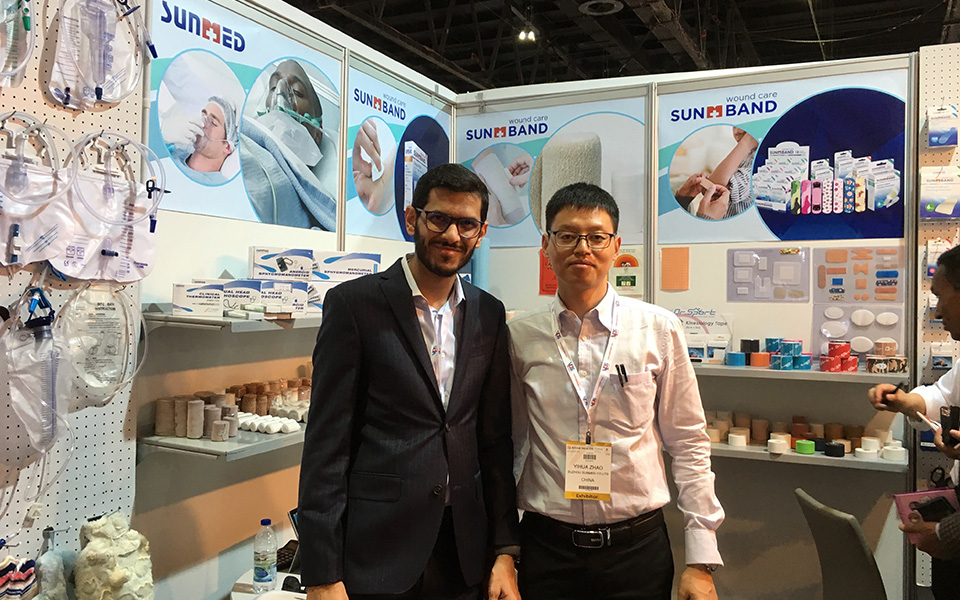
Suzhou Sunmed Co., Ltd. states that its quality-control organization includes hundreds of personnel and that its inspection procedures follow ISO 13485:2016 requirements. This quality-management standard is specifically associated with medical-device organizations and emphasizes controlled processes, risk-based thinking, documentation, product realization, and continual improvement.
The company also indicates that most of its products are CE certified and that its Suzhou factories comply with FDA requirements. Certification and regulatory status may vary by product, market, and configuration, so importers and professional buyers should request current certificates, declarations, technical files, and applicable test reports for the exact PE tape model under consideration.
Important Quality Checks
Typical inspection areas for medical PE tape may include:
Visual appearance of the film and adhesive coating.
Width and length verification.
Roll winding quality and core alignment.
Perforation spacing, consistency, and tear performance.
Adhesion and peel characteristics.
Tensile strength and elongation of the backing.
Air and water-vapor permeability where applicable.
Packaging integrity and label accuracy.
Lot traceability and production records.
Testing requirements should be based on the intended use, applicable standards, customer specifications, and target market regulations. A responsible supplier should be able to explain which tests are performed routinely and which tests are completed for specific orders or regulatory submissions.
Manufacturing Strengths and Supply Capabilities
The manufacturer’s broader experience is an important consideration when selecting a medical PE tape supplier. Suzhou Sunmed Co., Ltd. describes itself as a professional manufacturer and exporter of first-aid, medical, and healthcare products, with approximately 30 years of experience in medical devices and medical consumables.
Its product scope includes wound dressings, medical gauze, bandages, medical cotton, nonwoven medical products, sports bandages, kinesiology tape, cohesive bandages, elastic adhesive bandages, hot and cold packs, pill boxes, disposable syringes, catheters, surgical consumables, and other healthcare products. This broad portfolio indicates experience across several related materials, production technologies, packaging formats, and customer requirements.
The company operates multiple production bases in Jiangsu, Zhejiang, and Anhui Province. A multi-site manufacturing structure can provide additional production capacity, product specialization, and supply flexibility, although buyers should confirm the specific production location, quality system, and regulatory documentation for each PE tape order.
The company reports exports to more than 60 countries, including markets in Europe, Southeast Asia, Africa, and Oceania. International experience can be valuable for customers that require export documentation, multilingual packaging, private labeling, container planning, and communication across different regulatory environments.
Its stated market coverage includes hospitals, first-aid suppliers, supermarkets, and retail sports shops. This variety suggests familiarity with both institutional procurement and consumer-oriented product presentation.
Customization for Distributors and Private-Label Buyers
Medical product distributors often need specifications that differ from standard catalog items. Customization may involve dimensions, roll length, color, core type, spool material, label design, carton artwork, blister format, dispenser structure, or case quantity.
For PE tape, common customization requests include:
Alternative widths and lengths.
Transparent, blue, glossy, or matte appearances.
Paper cores or transparent plastic cores.
PP, PS, or ABS spool options.
Bulk packaging for hospitals and wholesalers.
Individual blister packs for retail and pharmacy channels.
Dispenser packaging for rapid point-of-care use.
Private-label printing and customized carton quantities.
Mixed-size product sets for first-aid kits.
Customization should not be limited to appearance. Buyers should also discuss adhesive performance, perforation pattern, roll tension, core dimensions, storage life, intended market, and required compliance documents. A clear technical specification reduces misunderstandings and helps the manufacturer prepare an appropriate sample before mass production.
OEM Development Process
A practical OEM development process generally begins with a written product brief. The brief should describe the intended application, target users, preferred dimensions, packaging requirements, estimated annual volume, sales market, and regulatory expectations.
The manufacturer can then recommend an existing product configuration or prepare a sample with adjusted dimensions and packaging. Sample evaluation should include ease of tearing, adhesion, roll stability, packaging appearance, and compatibility with the buyer’s distribution system.
After sample approval, the parties can confirm the final specifications, quality standard, artwork, inspection plan, production schedule, and shipping terms. Documented approval is particularly important when the product will be sold under a private label or registered in a regulated market.
Storage, Handling, and Use Recommendations
Medical PE tape should be stored in a clean, dry environment protected from direct sunlight, excessive heat, high humidity, dust, and chemical contamination. Rolls should remain in their original packaging until needed. Heavy objects should not be placed on cartons because compression can deform the rolls or packaging.
Before use, healthcare workers should inspect the package and roll for damage, contamination, or visible defects. The skin or surface should be prepared according to the relevant clinical procedure. When applying tape to skin, excessive stretching should be avoided unless the product’s instructions specifically support that technique.
Removal should be performed slowly and carefully, especially for infants, elderly patients, patients with fragile skin, and individuals with known adhesive sensitivity. The tape should not be used beyond its intended purpose or applied to damaged skin unless directed by an appropriate healthcare professional.
Storage life and environmental requirements may vary by adhesive formulation and packaging configuration. Buyers should use the shelf-life information and storage instructions supplied for the specific product batch.
Why Width Selection Matters
The choice of tape width affects both fixation performance and patient comfort. Narrow tape is often convenient for small dressing edges, lightweight tubing, and localized fixation. Wider tape can provide more surface contact and may be more suitable for larger dressings or broader support requirements.
The 1.25 cm width is compact and practical for small fixation tasks. The 2.5 cm width is a versatile general-purpose option for many first-aid and nursing applications. The 5 cm width provides broader coverage for larger dressings, while the 7.5 cm width can be considered when a wider securing strip is needed. The 10 cm option may serve specialized applications where extensive coverage is required.
Width should be selected according to the size and weight of the dressing or device, the condition of the skin, the expected duration of wear, and the need for inspection or dressing changes. Wider is not always better; excessive coverage may reduce convenience or make removal more difficult.
Comparing PE Tape with Other Medical Tape Materials
Medical tape is available in several backing materials, including nonwoven fabric, paper, cloth, plastic film, and specialty elastic materials. Each type has different characteristics.
| Backing Type |
Common Strength |
Typical Consideration |
| PE film |
Transparency, flexibility, easy tearing, moisture and vapor permeability when perforated |
Perforation and adhesive quality must be carefully controlled |
| Paper |
Soft feel and easy tearing |
May have lower resistance to moisture and handling stress |
| Nonwoven fabric |
Conformability and breathability |
Usually opaque and may have different tear characteristics |
| Cloth |
Strength and durability |
May be less transparent and less suitable where visual inspection is needed |
| Elastic backing |
Stretch and movement accommodation |
Typically intended for specialized fixation or support applications |
PE tape is not intended to replace every other medical tape. Its advantage is its particular combination of transparency, flexibility, perforated breathability, controlled adhesion, and hand-tear convenience. The correct selection depends on the clinical application and user requirement.
Commercial Value for Healthcare Buyers
For wholesalers, distributors, hospitals, and retailers, product value includes more than the unit purchase price. A reliable medical tape supplier can reduce operational problems associated with inconsistent roll quality, incorrect packaging, irregular dimensions, delayed deliveries, and inadequate documentation.
Standardized product codes simplify purchasing and inventory management. The four listed sizes provide a clear starting range for customers that want to cover common medical fixation needs. Different packaging quantities also support different sales channels: multi-piece boxes for institutional buyers, individual packs for retail, and bulk formats for repacking or first-aid kit assembly.
Reliable production can also reduce product returns. When tape tears unpredictably, unrolls poorly, has inconsistent adhesive, or arrives with damaged packaging, the resulting costs may include replacement freight, customer complaints, lost shelf space, and reduced confidence in the supplier.
A manufacturer with established quality systems, several production bases, export experience, and a broad medical product portfolio can potentially support more stable long-term cooperation. Buyers should still complete their own qualification process, including factory evaluation, sample testing, documentation review, and supply-capacity assessment.

Q&A About Transparent Medical PE Tape
What is medical PE tape?
Medical PE tape is a polyethylene film tape coated with a medical pressure-sensitive adhesive. It is designed to secure dressings, catheters, needles, tubing, and other lightweight medical components when used according to the product’s intended application.
Is transparent PE tape breathable?
Microperforated transparent PE tape allows air and water vapor to pass through the perforated film. The exact permeability depends on the film structure, hole pattern, adhesive coverage, and product design.
Can PE tape be torn by hand?
Yes. The evenly distributed perforations are designed to create a controlled tear line. The tape can generally be torn in both directions, making it convenient for clinical and first-aid use.
What sizes are available?
Listed standard sizes include approximately 1.25 cm, 2.5 cm, 5 cm, and 7.5 cm widths, corresponding to one-half inch, one inch, two inches, and three inches. Other widths and lengths, including 10 cm and different roll lengths, may be customized.
What packaging options are available?
Possible packaging formats include bulk rolls, plastic spools, blister packs, and dispensers. Packaging can be adapted for institutional, retail, pharmacy, first-aid, or private-label programs.
What materials can be used for the spool?
Plastic spools may be produced from polypropylene, polystyrene, or ABS. Paper cores and transparent cores are also available depending on the product configuration.
Is PE tape suitable for sensitive skin?
The product is positioned as a hypoallergenic medical tape, but individual responses vary. Users should follow product instructions, monitor the skin, and discontinue use if irritation or an adverse reaction occurs.
Can PE tape be used to secure an intravenous catheter?
It may be used for catheter or needle fixation when the product is approved and selected for that purpose and when the application follows appropriate clinical procedures. The tape should not obstruct the insertion site or interfere with inspection and treatment.
How does PE tape compare with paper tape?
PE tape can provide transparency, flexible film performance, and perforated breathability. Paper tape may provide a different soft feel and handling profile. The most suitable option depends on the application, skin condition, moisture exposure, and required visibility.
What should buyers request from a manufacturer?
Buyers should request technical specifications, sample rolls, packaging details, shelf-life information, quality certificates, applicable regulatory documents, test reports, lot-traceability information, and clear confirmation of the production site and inspection process.
Can a supplier provide private-label PE tape?
Private-label production may be available for customized dimensions, artwork, labels, cartons, blister packs, spools, and case quantities. The final program should be confirmed through a written specification and approved sample.
Why is perforation consistency important?
Consistent perforation supports easy tearing while preserving the tape’s strength during handling. Uneven perforations can cause irregular tearing, weak sections, poor appearance, or difficulty dispensing the product.
How should the tape be stored?
The tape should generally be stored in a clean, dry environment away from direct sunlight, excessive heat, high humidity, dust, and chemicals. The exact storage and shelf-life requirements should be confirmed using the product documentation for the relevant batch.
Conclusion
Transparent medical PE tape is a practical fixation product that combines a flexible polyethylene backing, medical pressure-sensitive adhesive, controlled hand tearing, and useful visibility. Its microperforated construction can provide high permeability to air and water vapor, while its balanced adhesive system supports dressing fixation and the stabilization of light medical components.
The product range includes common widths from approximately 1.25 cm to 7.5 cm, with additional sizes, lengths, cores, spools, and packaging formats available for customized programs. These options allow the same basic product platform to serve hospitals, first-aid suppliers, pharmacies, retailers, emergency kits, home-care users, and private-label distributors.
Its advantages over general-purpose tape come from specialized medical design: skin-oriented adhesive selection, controlled perforation, consistent roll construction, flexible film performance, and packaging developed for healthcare distribution. Manufacturing quality is equally important. Raw-material control, uniform coating, accurate perforation, precise slitting, stable winding, complete inspection, and reliable packaging all contribute to the final user experience.
Suzhou Sunmed Co., Ltd. combines a broad medical-product portfolio with stated experience spanning approximately three decades, multiple production bases, international export activity, and quality procedures aligned with ISO 13485:2016 requirements. For professional buyers, the most effective purchasing approach is to evaluate the exact PE tape configuration, confirm regulatory documentation, test samples, review packaging and storage requirements, and establish a documented quality agreement before large-scale procurement.
When these factors are managed properly, medical PE tape can deliver a dependable balance of comfort, usability, performance, and commercial flexibility across a wide range of healthcare applications.
References
ISO 13485:2016. Medical Devices—Quality Management Systems—Requirements for Regulatory Purposes.
International Organization for Standardization. Guidance on Quality Management and Risk Management for Medical Device Manufacturers.
United States Pharmacopeia. General Principles for Medical Device Materials and Packaging Quality.
European Commission. General Principles Applicable to Medical Devices and Conformity Assessment.
Technical Product Information. Transparent Microperforated Polyethylene Medical Tape, Standard Product Specifications and Packaging Configurations.
Medical Adhesive Tape Manufacturing Practice. Principles of Film Coating, Perforation, Slitting, Winding, and Quality Inspection.
Clinical Nursing Practice References. Principles for the Application, Monitoring, and Removal of Medical Adhesive Tape.

 English
 Español
 русский
 Français
 Deutsch
 italiano
 By Admin