Workplace injuries can occur in any environment, from offices and retail premises to warehouses, construction areas, workshops, schools, transport facilities, and manufacturing plants. A small cut, eye irritation, sprain, burn, or puncture wound may require immediate attention before professional medical assistance becomes available. For this reason, an appropriately stocked first aid kit is an essential part of occupational health and safety planning.
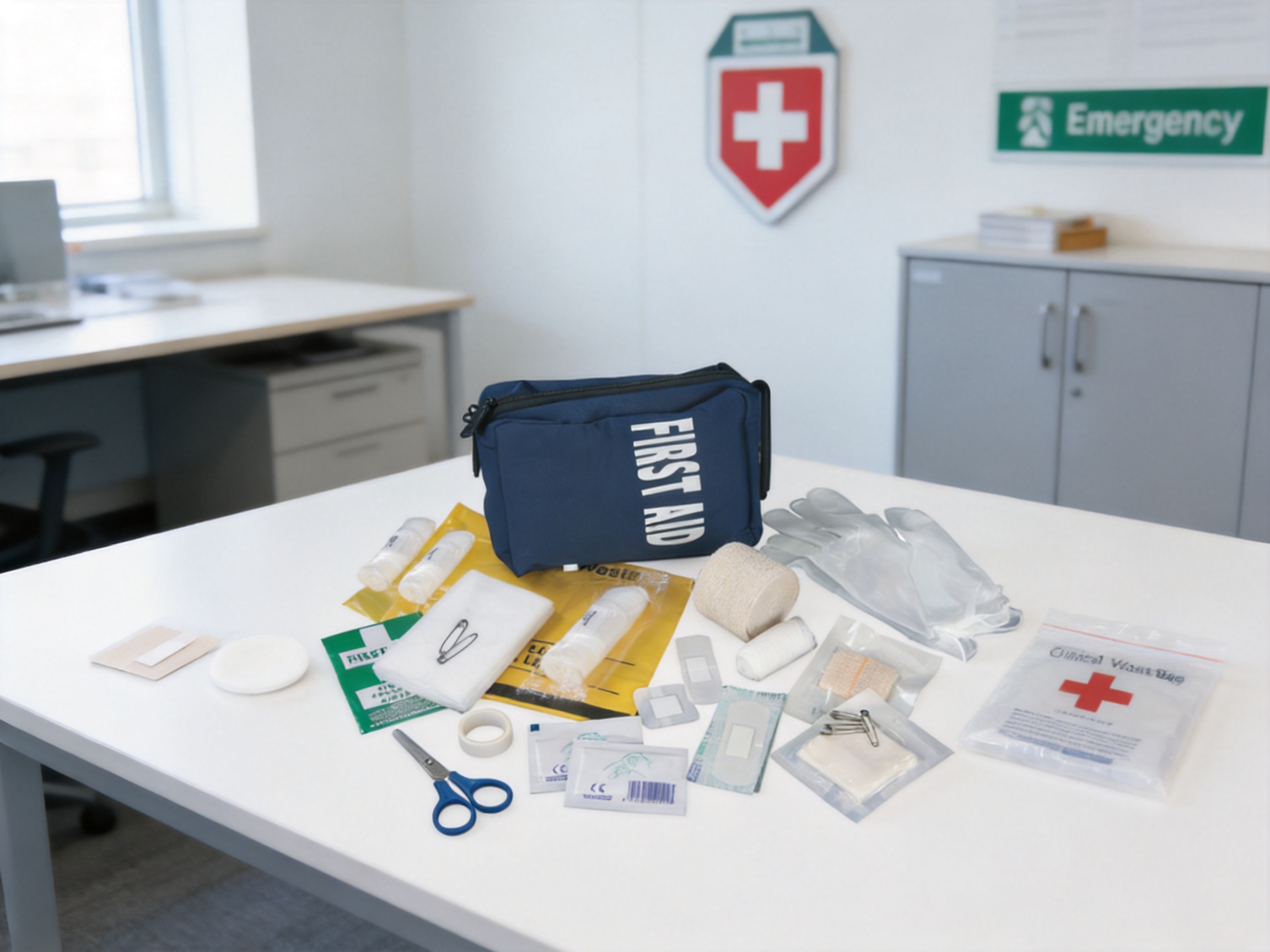
The Work First Aid Kit, product code SMD-110701, is designed as a compact and versatile workplace medical supply package. It combines wound dressings, bandages, eye protection, antiseptic wipes, adhesive plasters, gauze, gloves, scissors, safety pins, a clinical waste bag, and first aid guidance in one organized set. Its contents are selected to support the initial treatment of common minor injuries and to help workplaces respond quickly and hygienically.
Rather than containing only adhesive plasters, this kit provides several layers of first aid support. It includes products for covering wounds, controlling minor bleeding, protecting the eye, securing dressings, supporting injured limbs, cleaning the surrounding skin, protecting the first aider, and disposing of contaminated materials. This broader configuration gives it practical advantages over basic household kits or narrowly focused office kits.
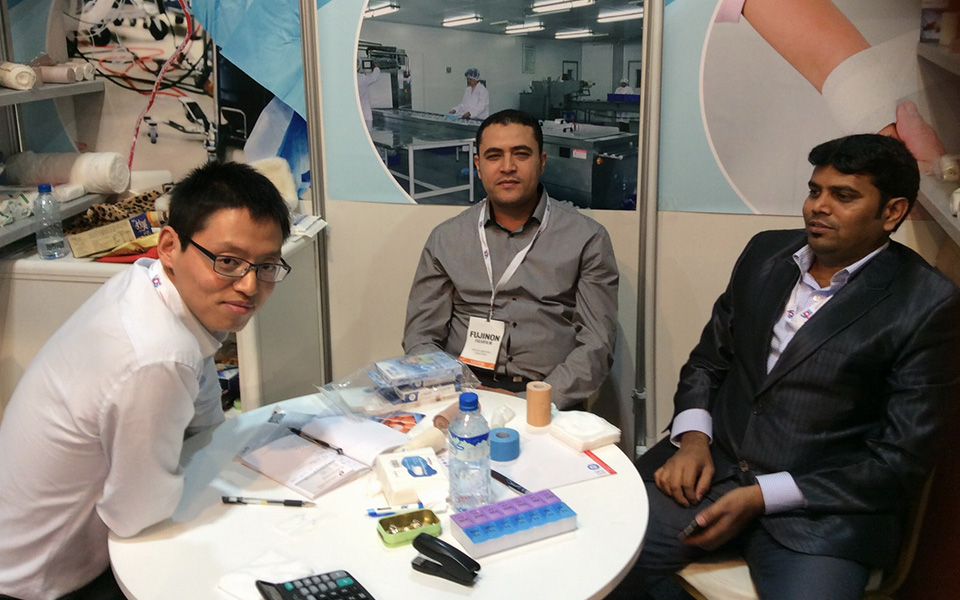
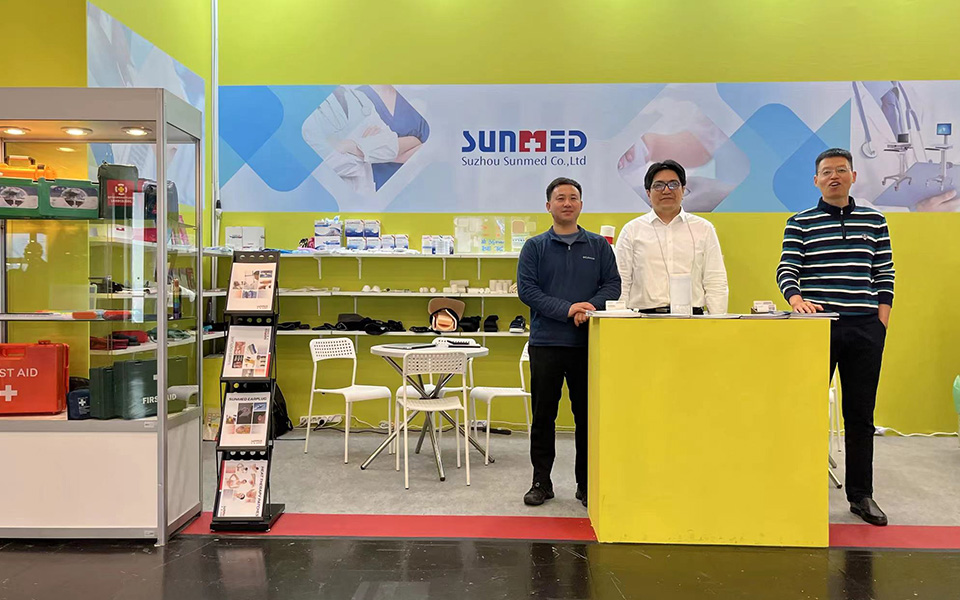
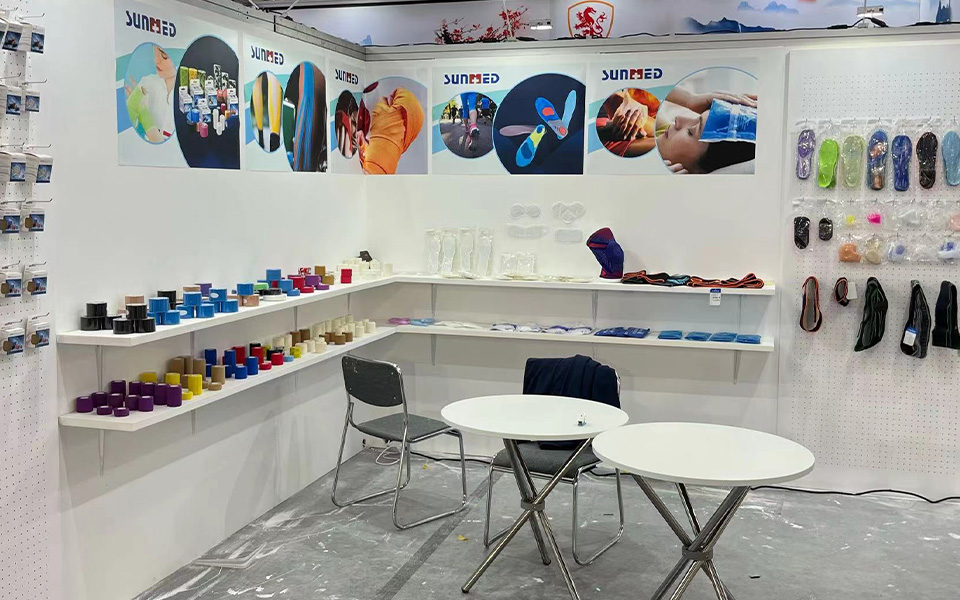
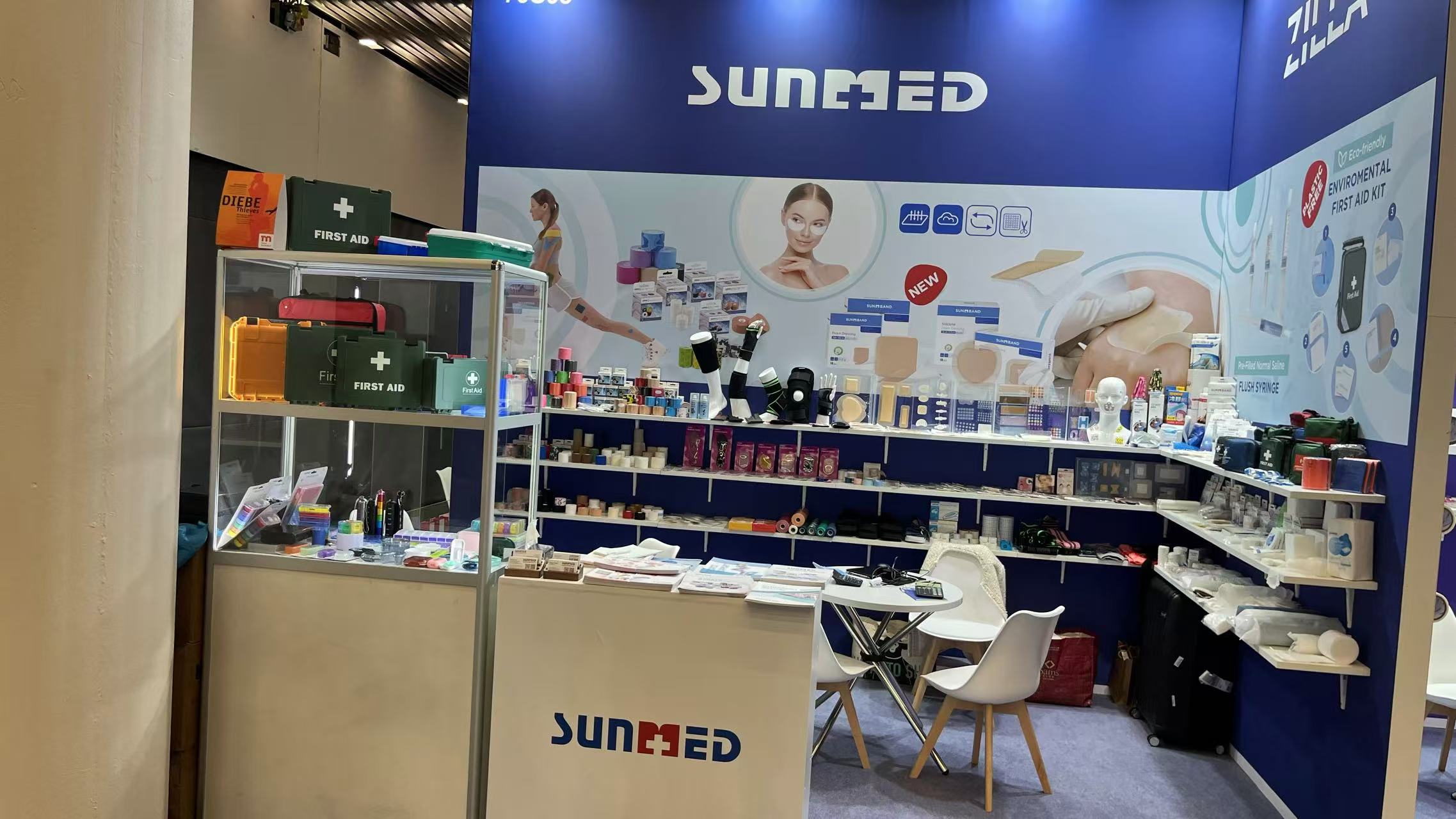
The kit is manufactured and supplied by Suzhou Sunmed Co., Ltd., a professional producer and exporter of first aid, medical, and healthcare products. The company operates production bases in Jiangsu, Zhejiang, and Anhui Province and has approximately 30 years of experience in medical devices and medical consumables. Its product expertise covers first aid, wound care, medical gauze, bandages, medical tape, cotton products, non-woven products, sports support products, family healthcare supplies, medical instruments, and surgical consumables.

Work First Aid Kit
1. Product Overview
The Work First Aid Kit is a ready-to-use collection of essential first aid components intended for workplaces and shared-use environments. It is identified by the model number SMD-110701 and is categorized as a First Aid Kit. The configuration is suitable for situations where employees, visitors, teachers, customers, or other personnel may need immediate basic care for minor injuries.
The central advantage of a preassembled kit is convenience. A workplace manager does not need to purchase every item separately, compare different product formats, or determine how many different supplies are required for basic incidents. The kit arrives with a defined contents list, allowing the responsible person to inspect, store, and replenish the set more efficiently.
Its contents address several common first aid requirements:
• Basic first aid information for initial guidance.
• Sterile and non-sterile dressing options for wound coverage.
• Eye pad protection for minor eye-related incidents.
• Conforming and crepe bandages for securing dressings or providing support.
• Antiseptic wipes for convenient cleansing around minor wounds.
• Microporous tape for fixing gauze and dressings.
• Vinyl gloves for reducing direct contact during first aid procedures.
• Scissors for cutting tape, dressings, or clothing when necessary.
• Assorted washproof plasters for small cuts and abrasions.
• A triangular bandage for temporary support or sling applications.
• A clinical waste bag for the controlled disposal of used materials.
• Safety pins for securing bandages and triangular bandages.
• A finger bandage for localized finger injuries.
• Sterile eight-ply gauze for wound coverage and absorption.
This combination makes the kit more capable than a simple box containing only assorted adhesive strips. It is also more manageable than an oversized emergency case filled with specialized products that may not be needed for routine workplace incidents.
2. Detailed Contents and Their Practical Functions
2.1 First Aid Guidance
One first aid guidance item is included in the kit. Written guidance can help a designated first aider follow a logical response sequence, particularly when an incident is unexpected or stressful. Basic guidance may support decisions such as protecting the responder, using gloves, assessing the injury, controlling minor bleeding, covering the wound, and seeking further medical assistance when required.
Printed guidance does not replace formal first aid training or professional medical advice. However, it can serve as a useful reminder and can help standardize the initial response in a workplace. It may also assist visitors or newly appointed workplace personnel who need to identify the contents and understand their general purpose.
2.2 First Aid Dressings
The kit includes one first aid dressing No. 9 and one first aid dressing No. 8. Multiple dressing sizes allow users to select an option that more closely matches the wound. A suitable dressing can reduce the need to fold or excessively overlap materials, which may improve handling during an urgent response.
First aid dressings are commonly used to cover minor wounds and absorb limited blood or exudate. They can also provide a protective barrier against dirt and friction. The correct application depends on the nature and severity of the injury. Deep, heavily bleeding, contaminated, or penetrating wounds require prompt professional assessment rather than treatment with a basic workplace kit alone.
2.3 Eye Pad Bandage
One eye pad bandage No. 16 is supplied for temporary protection of an injured or irritated eye. An eye pad can help prevent unnecessary rubbing and reduce exposure to external contamination while the person receives further evaluation.
Eye injuries require particular care. The eye should not be pressed, and embedded objects should not be removed by untrained personnel. In cases involving chemicals, sharp objects, impaired vision, severe pain, or suspected penetration, emergency medical procedures should be followed immediately. The eye pad in this kit is intended as a first aid component, not as a substitute for urgent clinical treatment.
2.4 Conforming and Crepe Bandages
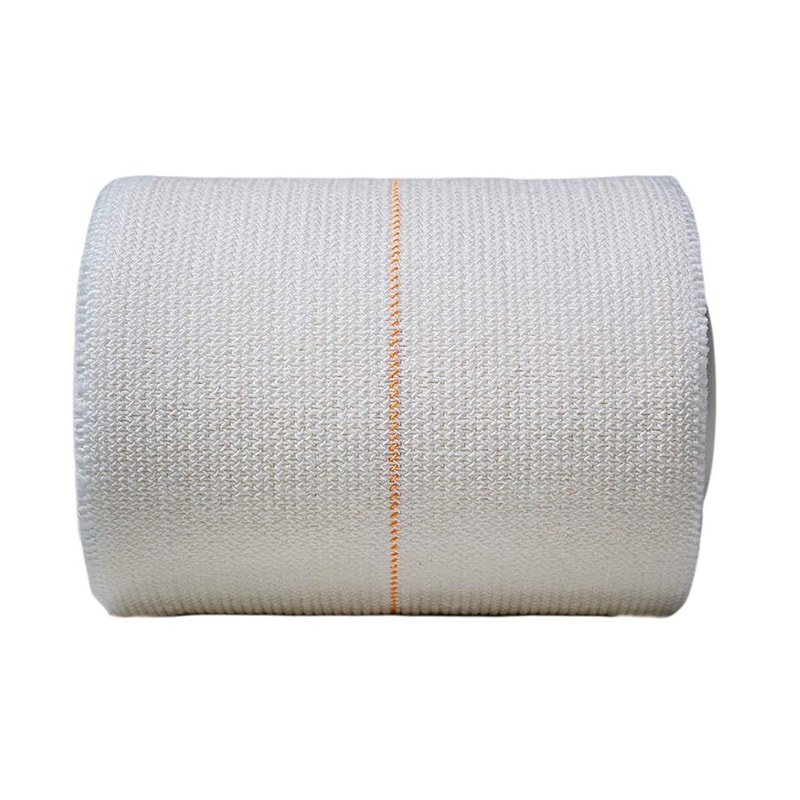
The kit includes one conforming bandage measuring 7.5 centimeters by 4.5 meters and one crepe bandage measuring 7.5 centimeters by 4.5 meters when stretched. These bandages are useful for securing dressings in place and providing light support around a limb or joint.
A conforming bandage is designed to follow body contours and can be used to hold gauze or a dressing over a wound. A crepe bandage can provide additional support in suitable circumstances, such as a minor strain or sprain, when used by a trained person. Bandages should not be wrapped so tightly that they restrict circulation. Fingers and toes should be monitored for changes in color, temperature, sensation, or swelling.
2.5 Antiseptic Wipes
Four antiseptic wipes are included. Individually packaged wipes are convenient because they can be used without preparing water, opening a large bottle, or measuring a liquid antiseptic. Their compact format is particularly suitable for workplace kits, mobile first aid stations, vehicles, and storage areas where space is limited.
Antiseptic wipes are generally used to clean the surrounding skin or hands when appropriate. The specific formulation and intended use should always be checked on the packaging. Some antiseptic products are not suitable for eyes, deep wounds, mucous membranes, or individuals with known sensitivities.
2.6 Microporous Medical Tape
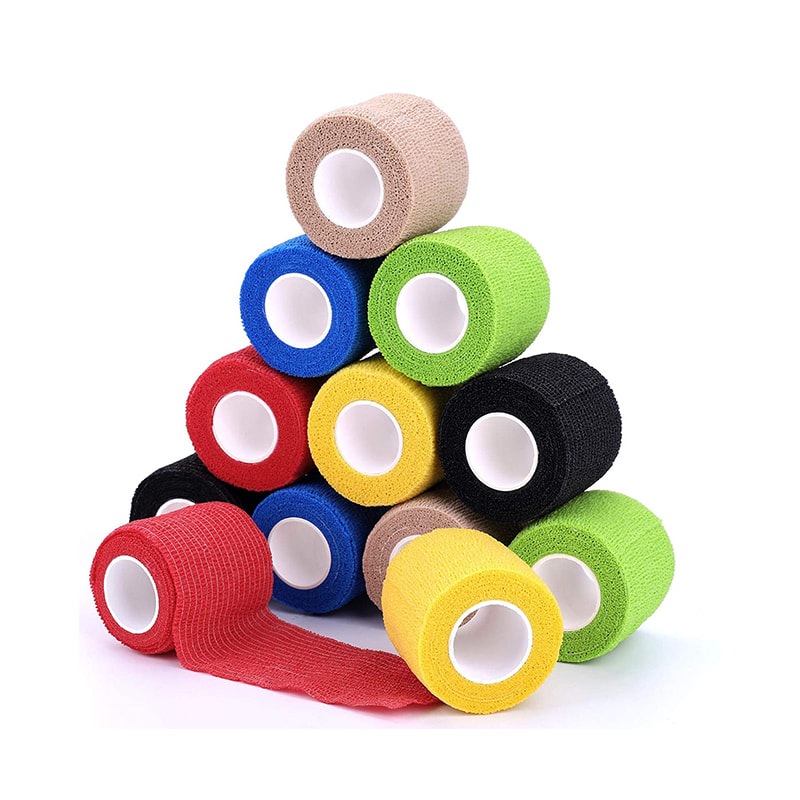
One roll of microporous tape measuring 1.25 centimeters by 3 meters is included. Medical tape is used to secure gauze, wound dressings, or the ends of bandages. Microporous tape is valued in many first aid applications for its light handling characteristics and practical utility.
The tape should be applied to clean, dry surrounding skin when possible. It should not be wrapped tightly around a finger or limb, and it should be removed carefully if the user experiences irritation. Including tape in the same kit as sterile gauze and dressings eliminates the need to search for a separate fastening product.
2.7 Vinyl Gloves
One pair of medium vinyl gloves is supplied. Gloves help create a protective barrier between the first aider and bodily fluids or contaminated materials. They also support more hygienic handling of dressings, gauze, and used supplies.
Because the kit contains one medium pair, workplaces with higher injury frequency or larger staffing levels may wish to keep additional gloves available. Employers should also consider glove sizing, allergy considerations, workplace risk assessments, and local occupational safety requirements.
2.8 Scissors
The kit includes scissors with a plastic handle and a length of 10.5 centimeters. Scissors can be used to cut medical tape, gauze, bandages, or clothing when access to an injury is restricted. A plastic handle can offer a lightweight and practical format for general first aid storage.
Scissors should be stored securely and handled carefully. In a workplace setting, a responsible person should inspect them periodically to ensure that the blades remain clean, functional, and free from damage.
2.9 Washproof Adhesive Plasters
Twenty assorted washproof plasters are included. Assorted sizes allow the user to select a suitable plaster for small cuts, grazes, blisters, or superficial abrasions. A washproof format can help the plaster remain attached during routine contact with water, although no adhesive plaster should be considered completely waterproof in every situation.
Adhesive plasters are among the most frequently used first aid items in offices, schools, retail premises, and industrial locations. Including 20 pieces gives the kit practical capacity for repeated minor incidents rather than a single use.
2.10 Triangular Bandage
One non-woven triangular bandage measuring 90 by 90 by 127 centimeters is included. A triangular bandage can be folded or used as a sling to support an arm, secure a dressing, or stabilize an injured area temporarily. Its large triangular shape gives it flexibility in situations where a standard roll bandage may not be sufficient.
The triangular bandage is intended for temporary first aid support. Any suspected fracture, dislocation, serious joint injury, or injury involving severe pain or deformity requires medical evaluation. The bandage should be positioned in a manner that avoids unnecessary pressure and allows circulation to be monitored.
2.11 Clinical Waste Bag
One clinical waste bag is included for the controlled collection of used gloves, wipes, dressings, and other contaminated disposable materials. Waste management is an important part of first aid because used materials may contain blood or other biological fluids.
The bag should be handled according to the workplace’s waste disposal procedure and applicable local requirements. Its inclusion demonstrates that the kit is designed not only around treatment materials but also around cleanliness and post-incident management.
2.12 Safety Pins
Six assorted safety pins are provided. Safety pins can be used to secure a triangular bandage or hold a temporary bandage arrangement in place. Assorted sizes offer flexibility for different fabric thicknesses and bandage configurations.
Safety pins should be used carefully and kept away from children or anyone unable to handle them safely. They should not be inserted into the body or used in a manner that could puncture the skin.
2.13 Finger Bandage
One finger bandage measuring 3.5 by 3.5 centimeters is included for localized finger injuries. Fingers are vulnerable to cuts, abrasions, pinches, and small puncture wounds in many workplaces. A dedicated finger dressing can be easier to apply than a general dressing that requires extensive folding or cutting.
Finger injuries should be checked for circulation, movement, sensation, and foreign objects. A wound involving a tendon, nail bed, joint, severe bleeding, or loss of sensation should be referred for professional assessment.
2.14 Sterile Gauze
Two packs of sterile gauze are included, with each pack described as five pieces of 5 by 5 centimeter, eight-ply gauze. Sterile gauze provides an absorbent material for covering wounds and can be used beneath a bandage or secured with microporous tape.
The eight-ply construction offers a practical balance between compact storage and absorbency for basic first aid use. Sterile packaging helps preserve the intended cleanliness of the gauze until the package is opened. The packaging should be checked before use, and any package that is damaged, wet, or expired should be replaced.
3. Product Configuration at a Glance
The following table summarizes the supplied contents of the Work First Aid Kit.
| Item |
Specification |
Quantity |
Primary Use |
| First aid guidance |
Printed guidance |
1 |
Basic response reference |
| First aid dressing No. 9 |
Standard dressing format |
1 |
Wound coverage and absorption |
| First aid dressing No. 8 |
Standard dressing format |
1 |
Wound coverage and absorption |
| Eye pad bandage No. 16 |
Eye pad format |
1 |
Temporary eye protection |
| Conforming bandage |
7.5 cm x 4.5 m |
1 |
Securing dressings |
| Crepe bandage |
7.5 cm x 4.5 m stretched |
1 |
Light support and securing |
| Antiseptic wipe |
Individual wipe |
4 |
Convenient cleansing support |
| Microporous tape |
1.25 cm x 3 m |
1 |
Fixing gauze and dressings |
| Vinyl gloves |
Medium, one pair |
1 pair |
Barrier protection |
| Scissors |
Plastic handle, 10.5 cm |
1 |
Cutting tape, gauze, or clothing |
| Washproof plasters |
Assorted sizes |
20 |
Minor cuts and abrasions |
| Triangular bandage |
Non-woven, 90 x 90 x 127 cm |
1 |
Temporary support or sling |
| Clinical waste bag |
Disposable waste bag |
1 |
Containing used materials |
| Safety pins |
Assorted sizes |
6 |
Securing bandages |
| Finger bandage |
3.5 x 3.5 cm |
1 |
Localized finger wound coverage |
| Sterile gauze |
5 x 5 cm, eight-ply, five pieces per pack |
2 packs |
Absorbent sterile wound coverage |
4. Advantages Compared with Basic Workplace Kits
4.1 Broader Coverage of Common Incidents
Many basic workplace first aid boxes focus primarily on adhesive plasters, a small quantity of gauze, and perhaps a pair of gloves. The Work First Aid Kit provides a broader range of components, including an eye pad, triangular bandage, crepe bandage, conforming bandage, clinical waste bag, safety pins, and finger dressing.
This broader coverage is valuable because workplace injuries are not limited to small surface cuts. Employees may experience strains, minor sprains, eye irritation, finger injuries, abrasions, or wounds that require a dressing to be held securely. The contents support a more adaptable initial response without making the kit unnecessarily specialized.
4.2 Integrated Dressing and Fixation Materials
A dressing is only useful if it can remain in the correct position. This kit combines first aid dressings and sterile gauze with microporous tape, conforming bandage, crepe bandage, and safety pins. That combination allows the user to select an appropriate method of securing the wound covering.
By contrast, a kit containing only loose gauze may require additional products before it can be used effectively. The integrated configuration reduces this problem and improves practical readiness.
4.3 Support for Hygienic First Aid
The inclusion of vinyl gloves, antiseptic wipes, and a clinical waste bag provides a basic hygiene sequence: protect the responder, use suitable cleansing materials, apply the dressing, and manage used supplies afterward. This is a more complete approach than focusing only on the visible wound.
Good first aid organization can reduce unnecessary handling and help the workplace maintain a cleaner response area. It can also make it easier for supervisors to explain expected procedures during staff training.
4.4 Compact but Functional Selection
The kit avoids an excessively large assortment of low-frequency items. Instead, it emphasizes supplies that can address common minor injuries while still including a few versatile products, such as the triangular bandage and crepe bandage.
This balance can be advantageous for workplaces that need a kit that is easy to store in a reception area, office cabinet, staff room, vehicle, workshop, or other accessible location. A compact configuration also makes stock inspection and replacement simpler.
4.5 Suitable for Multiple Distribution Channels
The Work First Aid Kit can be positioned for use by industrial employers, offices, first aid suppliers, supermarkets, pharmacies, schools, sports facilities, retail stores, and institutional purchasers. Its contents are sufficiently general for broad workplace use while retaining specialized elements such as an eye pad and triangular bandage.
For distributors, a defined product code and standardized contents list can simplify product cataloging, purchasing, private-label discussions, and repeat ordering. For end users, the clear itemized structure supports easier comparison with workplace risk assessments.
5. Manufacturing and Quality Strengths
5.1 Experience in Medical Consumables
The manufacturer has approximately 30 years of experience in the medical device and medical consumables industry. This experience is important because a first aid kit is not simply a collection of unrelated items. The quality of the finished kit depends on product selection, material consistency, packaging control, labeling, storage, inspection, and the ability to coordinate multiple production categories.
Long-term experience can also support better understanding of customer requirements in different markets. Workplaces in Europe, Southeast Asia, Africa, Oceania, and other regions may have different purchasing specifications, packaging expectations, documentation requirements, and product combinations. A manufacturer with broad export experience is better positioned to manage these variables.
5.2 Multiple Production Bases
The company operates production bases in Jiangsu, Zhejiang, and Anhui Province. Multiple production locations can support manufacturing capacity, category specialization, and supply continuity. The company’s product range includes first aid supplies, wound dressings, medical gauze, bandages, medical tape, medical cotton, medical non-woven products, sports bandages, kinesiology tape, cohesive bandages, elastic adhesive bandages, family healthcare products, disposable syringes, catheters, surgical consumables, and other medical products.
This breadth is relevant to the Work First Aid Kit because many of its individual components belong to product categories that the manufacturer produces as part of its wider portfolio. Experience in gauze, bandages, tape, non-woven materials, and first aid supplies can support more consistent sourcing and coordinated quality control.
5.3 Dedicated First Aid Manufacturing Development
The company established its first aid factory in 2008 to meet the needs of first aid customers. This dedicated development indicates that first aid products are an established area of manufacturing rather than an incidental addition to a general trading catalog.
A dedicated first aid operation may support more efficient assembly of kits, standardized component selection, improved packing workflows, and more consistent handling of first aid product specifications. It also provides a foundation for developing different kit configurations according to market, workplace size, industry, or customer requirements.
5.4 Expansion into Sports and Adhesive Product Manufacturing
In 2021, the company established its own factory for kinesiology tape, cohesive bandages, and elastic adhesive bandages. These categories require knowledge of textiles, adhesive performance, elasticity, coating, cutting, winding, and packaging.
Although the Work First Aid Kit is not a sports support kit, experience with adhesive and bandage products can be valuable when producing or sourcing the conforming bandage, crepe bandage, microporous tape, adhesive plasters, and other wound support components included in the kit.
5.5 Quality Management and Inspection
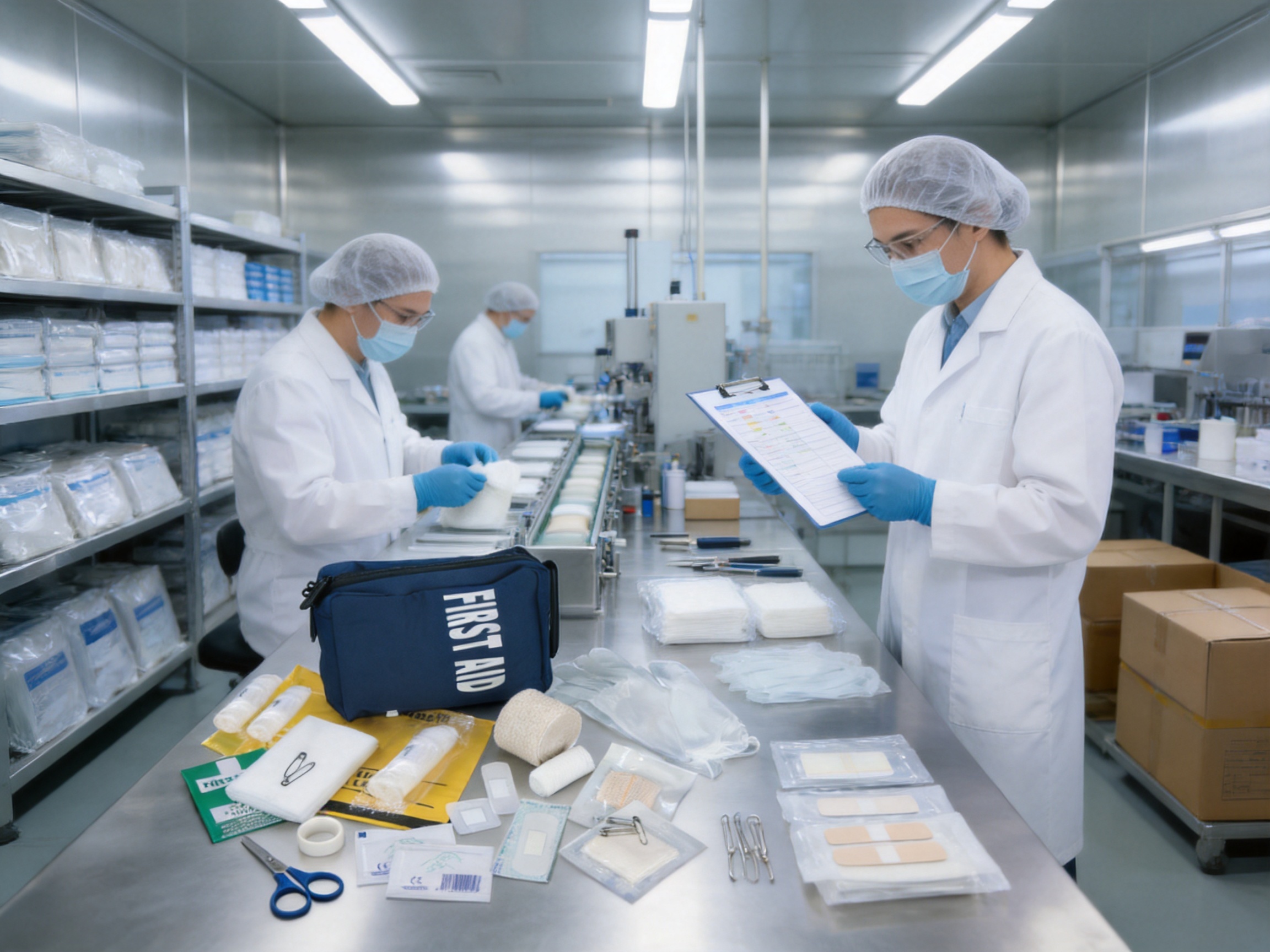
The company reports a professional quality control team comprising hundreds of personnel. Its inspection procedures are intended to support compliance with ISO 13485:2016 standards. ISO 13485 is an internationally recognized quality management standard for medical devices and related organizations. A quality management system based on this standard typically emphasizes documented processes, traceability, risk-based controls, supplier management, production consistency, corrective actions, and records.
For a multi-item kit, quality management is especially important. Each component must be checked individually, and the finished package must be checked as a complete unit. Typical control points may include item identity, quantity, dimensions, packaging condition, labeling, visual appearance, cleanliness, and assembly accuracy. The precise inspection plan depends on the component and applicable customer requirements.
The manufacturer also states that most products are CE certified and that its Suzhou factories comply with FDA requirements. Buyers should confirm the exact certification and regulatory status of the specific Work First Aid Kit configuration, including the destination market, product classification, packaging, and applicable documentation.
5.6 Export and Market Knowledge
The company has exported products to more than 60 countries, including markets in Europe, Southeast Asia, Africa, and Oceania. Its customer base includes hospitals, first aid suppliers, supermarkets, and retail sports shops.
International experience can provide practical advantages in packaging development, product documentation, shipping preparation, carton configuration, and communication with importers. It may also help the manufacturer understand that a product intended for a hospital procurement department may require a different presentation from a product intended for supermarket or sports retail distribution.
6. Manufacturing Process for a Multi-Item First Aid Kit
6.1 Product Planning and Specification Control
The process begins with a defined product specification. For SMD-110701, the specification includes the model number, product name, content list, sizes, quantities, and intended application as a work first aid kit. Maintaining a controlled specification helps prevent substitutions, quantity errors, and inconsistent production between batches.
Specification control is particularly important when a kit contains similar items. For example, first aid dressing No. 8, first aid dressing No. 9, an eye pad bandage, a finger bandage, and sterile gauze serve different functions and should not be treated as interchangeable components.
6.2 Raw Material and Component Sourcing
Materials may include cotton or non-woven substrates, elastic textile fabrics, adhesive coatings, protective films, sterile packaging materials, vinyl glove materials, plastic components, paper inserts, and waste bag film. Each material category requires suitable purchasing and incoming inspection criteria.
Reliable sourcing supports consistent product performance. Gauze should have the intended dimensions, ply, cleanliness, and packaging integrity. Bandages should have suitable elasticity or conformability. Tape should unwind appropriately and provide practical adhesion without unacceptable damage to the intended skin area when used according to its instructions.
6.3 Cutting, Folding, Winding, and Assembly
Different components require different processing methods. Gauze may be cut and folded into standardized sizes. Bandages may be woven, knitted, elasticized, rolled, or packaged according to their construction. Tape may be coated, slit, wound, and labeled. Non-woven triangular bandages may be cut and finished along their edges.
Assembly of the finished kit requires an additional level of control. Operators or automated systems must place the correct quantity of every item into the designated package. The contents list must correspond to the actual configuration, and the final package should be checked for missing, duplicated, or damaged components.
6.4 Packaging and Protection
Packaging protects the components during transport and storage. It also provides a surface for product identification, content information, batch details, instructions, and other customer-required markings. Sterile items must remain protected until use, while non-sterile accessories must be packed in a manner that prevents avoidable contamination or damage.
Packaging design should balance protection, usability, storage efficiency, and cost. A workplace kit should be easy to identify and open during an incident, yet sufficiently secure to prevent components from being lost during normal handling.
6.5 Finished Product Inspection
Finished inspection may include visual checks, quantity verification, dimensional checks, packaging review, labeling review, and sampling according to the quality plan. A final kit inspection should confirm that the contents match the product specification and that the package is intact.
For international orders, customers may also request pre-shipment inspection, private-label checks, carton inspections, or documentation review. These controls can help reduce errors before goods leave the factory.
6.6 Traceability and Continuous Improvement
Traceability enables a manufacturer to identify the relevant production records, raw materials, inspection results, and shipment information associated with a product batch. When a deviation is found, traceability supports investigation and corrective action.
Continuous improvement may involve revising work instructions, improving component storage, adjusting packaging methods, strengthening supplier controls, or updating inspection points. These activities are especially useful for a product assembled from numerous different medical consumables.
7. Recommended Workplace Applications
7.1 Offices and Commercial Buildings
Offices commonly require supplies for paper cuts, minor abrasions, small burns, slips, and occasional strains. The Work First Aid Kit provides suitable general-purpose items while remaining compact enough for a reception desk, facilities room, or central safety cabinet.
Commercial buildings can place the kit in an accessible location known to trained personnel. A second kit may be appropriate for larger buildings, multi-floor facilities, or premises with separate work areas.
7.2 Warehouses and Distribution Centers
Warehouses may present risks from packaging tools, shelving, manual handling, moving equipment, and uneven surfaces. The kit’s dressings, plasters, gauze, tape, gloves, bandages, and scissors can support an initial response to minor incidents.
Workplaces with higher hazards should complete a formal risk assessment and may need additional supplies, such as larger trauma dressings, burn treatment products, eye wash, additional gloves, or specialized emergency equipment.
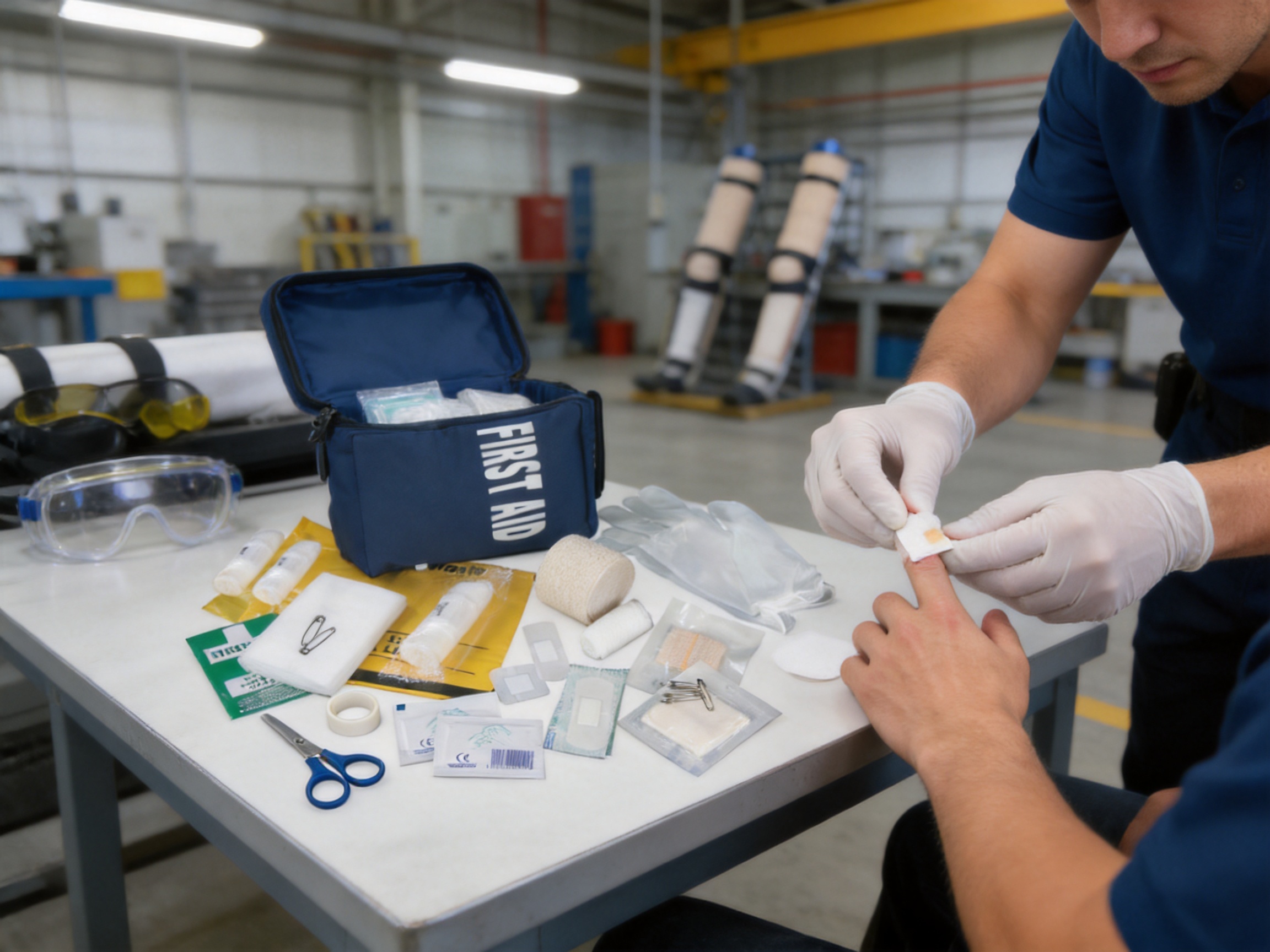
7.3 Workshops and Manufacturing Areas
Workshops and factories may experience cuts, punctures, abrasions, strains, and eye exposure incidents. The inclusion of an eye pad, finger dressing, conforming bandage, crepe bandage, and triangular bandage makes the kit more versatile than a plaster-only box.
Where chemicals, machinery, high temperatures, or sharp tools are present, the kit should be used as part of a broader safety system. Appropriate protective equipment, emergency showers, eye wash stations, machine guarding, training, and emergency procedures may also be required.
7.4 Schools, Training Centers, and Community Facilities
Schools and community facilities may need first aid supplies for minor cuts, grazes, sports-related strains, and eye irritation. The assortment of adhesive plasters and the inclusion of triangular and crepe bandages can support varied activities.
Administrators should consider the number and age of users, the location of sports areas, the presence of children, and the need for additional gloves or specialized items. Safety pins and scissors should be stored responsibly.
7.5 Vehicles and Mobile Work Teams
The compact format is also suitable for service vehicles, delivery teams, maintenance crews, outdoor events, and mobile work groups. A portable kit allows supplies to travel with the team rather than remaining only in a central building.
Mobile storage conditions should be considered. Extreme heat, freezing temperatures, moisture, and direct sunlight may affect certain materials, adhesives, packaging, or antiseptic products. The kit should be stored according to the component manufacturers’ instructions.
8. Storage, Inspection, and Replenishment
A first aid kit is effective only when it is accessible, complete, and in usable condition. The kit should be stored in a clearly identified location that is easy to reach but protected from unnecessary tampering. Employees should know where it is located and who is responsible for checking it.
A workplace inspection routine should verify the following:
• The kit is present and accessible.
• The contents list matches the items inside.
• Sterile packages are sealed and undamaged.
• Adhesive products remain in usable condition.
• Bandages and gauze are clean and correctly packaged.
• Antiseptic wipes have not dried out or passed their expiry date.
• Gloves are intact and suitable for the expected users.
• Scissors and safety pins are present and undamaged.
• The clinical waste bag is available.
• Used or expired products are replaced promptly.
After any incident, the responsible person should record which supplies were used and arrange replenishment. Regular scheduled inspections are also recommended, even when no incident has occurred, because products can be removed, damaged, misplaced, or affected by storage conditions.
Businesses should maintain additional stock when the workplace has a large number of employees, multiple shifts, several buildings, frequent visitors, or a higher likelihood of minor injuries. The standard kit is a practical starting point, but it should be adapted to the workplace risk assessment and local regulations.
9. Purchasing and OEM Considerations
For wholesale buyers, importers, first aid suppliers, and retailers, the Work First Aid Kit offers a defined starting configuration that can be ordered as a standard item or discussed as a basis for customization. Potential areas for discussion may include outer packaging, labeling, language versions, item quantities, private branding, carton markings, and market-specific documentation.
Before placing an order, buyers should confirm the final bill of materials, component specifications, packaging format, shelf-life information where applicable, minimum order quantity, production lead time, shipping carton details, and inspection requirements. They should also clarify whether the kit is sold as a general first aid supply set or is intended to meet a specific national workplace first aid standard.
Regulatory requirements can vary by destination. A buyer should verify whether the complete kit, individual components, or both require registration, conformity documentation, import permits, labeling in the local language, or other controls. The manufacturer can provide product and quality documentation appropriate to the agreed configuration, subject to confirmation during quotation and order review.
OEM and private-label programs can be useful for distributors that want a consistent product family. A manufacturer with experience in first aid, gauze, bandages, tape, cotton products, non-woven materials, sports supports, and medical devices may be able to coordinate several related products under one supply relationship.
10. Why Manufacturer Capability Matters
The quality of a first aid kit depends on more than the number of components inside the package. It depends on whether each component is fit for its intended use, whether the quantities are correct, whether sterile products remain protected, whether the labels are accurate, and whether the kit is assembled under controlled procedures.
A manufacturer with broad medical consumables expertise can bring category knowledge to every part of the process. Experience in gauze supports better understanding of absorbent wound coverings. Experience in bandages supports better control of textile construction, elasticity, and winding. Experience in medical tape supports attention to adhesive coating and roll quality. Experience in first aid kits supports practical assembly and packaging decisions.
Quality control personnel, documented inspection procedures, multiple production bases, and international market experience can further support consistent supply. These capabilities are particularly valuable for buyers who require repeat orders with the same configuration and predictable quality.
The stated compliance with ISO 13485:2016 quality management practices, CE certification for most products, and FDA-related compliance at the Suzhou factories demonstrates a quality-focused manufacturing orientation. Nevertheless, purchasers should always request and review current documentation for the exact product and destination market rather than relying only on general company-level statements.
11. Safe and Appropriate Use
The Work First Aid Kit is intended for basic first aid support. It is not an emergency trauma kit, surgical kit, diagnostic kit, or replacement for professional medical treatment. Users should follow the instructions supplied with individual products and use appropriate personal protective measures.
Professional medical attention should be sought for severe bleeding, deep or large wounds, suspected fractures, loss of consciousness, breathing difficulty, serious burns, major eye injuries, chemical exposure, animal bites, extensive contamination, signs of infection, or any injury that causes significant pain or loss of function.
First aiders should avoid procedures beyond their training. They should protect themselves, assess the scene for hazards, call emergency services when necessary, and avoid moving an injured person unless remaining in place presents an immediate danger. The kit can support the first response, but workplace emergency planning should include training, communication procedures, evacuation routes, incident reporting, and access to professional care.
12. Frequently Asked Questions
Q1: What is included in the Work First Aid Kit?
The kit includes first aid guidance, two first aid dressings, one eye pad bandage, one conforming bandage, one crepe bandage, four antiseptic wipes, one roll of microporous tape, one pair of medium vinyl gloves, scissors, 20 assorted washproof plasters, one triangular bandage, one clinical waste bag, six assorted safety pins, one finger bandage, and two packs of sterile eight-ply gauze.
Q2: What is the product code?
The product code is SMD-110701.
Q3: Is this kit suitable for offices?
Yes. Its contents are suitable for many common minor office injuries, including small cuts, abrasions, finger injuries, and minor strains. Offices should determine the number of kits required according to employee count, building layout, activities, and local workplace requirements.
Q4: Can the kit be used in factories or warehouses?
It can support initial treatment of minor injuries in factories and warehouses. However, workplaces with machinery, chemicals, heat, electrical hazards, or other elevated risks may need additional specialized equipment and a more extensive first aid assessment.
Q5: Does the kit include eye protection?
Yes. It includes one eye pad bandage No. 16 for temporary eye protection. Serious eye injuries, chemical exposure, embedded objects, or vision changes require urgent professional treatment.
Q6: Why are both conforming and crepe bandages included?
The two bandage types provide different practical options. A conforming bandage can help hold a dressing in place, while a crepe bandage can provide light support in appropriate first aid situations. Neither should be applied so tightly that circulation is restricted.
Q7: Are the gauze pieces sterile?
The listed gauze is described as sterile gauze, 5 by 5 centimeters, eight-ply, with five pieces per pack. Buyers should inspect the individual packaging before use and follow the product labeling and shelf-life information.
Q8: Are additional gloves recommended?
One medium pair is included. Additional gloves may be recommended for larger workplaces, repeated-use locations, multiple first aiders, or environments where bodily fluid exposure is more likely. Glove size and material should be selected according to workplace needs.
Q9: Can the product be customized?
Customization may be discussed for suitable wholesale or OEM projects. Possible subjects include branding, packaging, language, quantities, carton markings, and component selection. The final options depend on order volume, destination requirements, regulatory considerations, and production feasibility.
Q10: Is the kit certified for every country?
No single statement should be assumed to cover every country or every product configuration. Regulatory requirements vary by market. Buyers should request current documentation for the exact kit, verify the classification in the destination market, and confirm labeling and import requirements before ordering.
Q11: How should the kit be stored?
Store it in a clean, dry, accessible location protected from excessive heat, cold, moisture, direct sunlight, and unauthorized use. Follow the storage instructions on the individual component packaging and inspect the contents regularly.
Q12: How often should the kit be checked?
The kit should be checked according to the workplace’s safety procedure and after every use. Periodic scheduled inspections are also recommended to identify expired, missing, damaged, or contaminated items.
13. Conclusion
The Work First Aid Kit is a balanced workplace first aid solution that combines basic wound care, eye protection, bandaging, hygiene, support, and waste management in one organized package. Its 16 listed product categories and practical quantities make it more versatile than a simple plaster box while keeping the configuration manageable for offices, commercial premises, warehouses, workshops, schools, vehicles, and community facilities.
Its competitive value comes from the relationship between the components. Dressings and sterile gauze provide wound coverage. Tape, conforming bandages, crepe bandages, and safety pins help secure materials. The eye pad addresses a separate category of minor incident. Gloves, antiseptic wipes, scissors, and a clinical waste bag support a more hygienic response. The triangular bandage adds flexibility for temporary support.
The product is supported by a manufacturer with long-standing experience in medical consumables, dedicated first aid manufacturing, multiple production bases, a broad medical product portfolio, international export experience, and a substantial quality control organization. The company’s reported alignment with ISO 13485:2016 quality management practices and its stated CE and FDA-related capabilities provide a foundation for professional sourcing, subject to confirmation for the exact product and destination market.
For workplaces, the most important step is to match the kit with a documented risk assessment, appropriate training, accessible storage, routine inspection, and a clear replenishment procedure. For distributors and importers, the product offers a defined platform for wholesale supply and potential OEM adaptation. Used responsibly and maintained correctly, it can help organizations improve readiness for common minor injuries while supporting a more systematic approach to first aid management.
References
1. ISO 13485:2016, Medical Devices — Quality Management Systems — Requirements for Regulatory Purposes.
2. International first aid and workplace emergency response principles published by recognized occupational health and safety organizations.
3. General wound care and bandaging guidance from professional first aid training resources.
4. Manufacturer-provided product specification for Work First Aid Kit, model SMD-110701.
5. Manufacturer-provided company information concerning medical consumables production, quality control, export markets, and manufacturing facilities.
6. General workplace first aid kit inspection, storage, replenishment, and risk assessment practices.

 English
 Español
 русский
 Français
 Deutsch
 italiano
 By Admin